

KEY POINTS
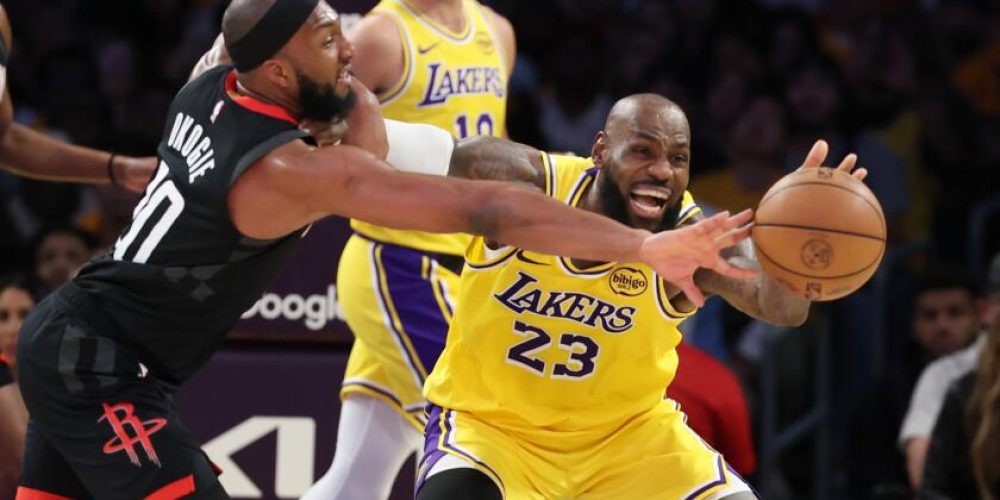
- The Los Angeles Lakers secured a 107-98 victory over the Houston Rockets in Game 1 of their opening-round series.
- Kevin Durant was sidelined for the Rockets due to a right knee contusion sustained during practice earlier in the week.
- Luke Kennard led the Lakers with a career-high 27 points, helping overcome the absence of key stars Luka Doncic and Austin Reaves.
The NBA postseason kicked off with a major plot twist as the Houston Rockets were forced to navigate their opening playoff contest without superstar Kevin Durant. Despite the absence of their offensive anchor, the Rockets were favored in many eyes, but the Los Angeles Lakers utilized a collective effort to secure a surprising Game 1 win at Crypto.com Arena. The victory provides the Lakers with critical momentum as they attempt to advance through a challenging first-round bracket.
What You Need to Know
This series represents one of the most compelling matchups of the 2026 NBA playoffs, primarily due to the star-studded rosters and the high stakes involved for both franchises. For the Rockets, the acquisition of Kevin Durant was designed to elevate the team into immediate title contention, pairing seasoned veteran leadership with an ascending young core. His injury, described as a right knee contusion, arrived at the most inopportune moment, forcing the team to recalibrate its offensive identity on the fly.
On the opposing side, the Lakers entered the series facing significant adversity of their own. Injuries to star players Luka Doncic and Austin Reaves have left the team operating with a thin rotation, placing an immense burden on veteran leader LeBron James. The prevailing narrative leading into the opener was whether the Lakers could muster enough firepower to keep pace with a full-strength Houston squad, making the outcome of this first game a litmus test for Los Angeles’ depth and resilience.
Lakers Rally to Overpower Houston
The game unfolded as a testament to team defense and opportunistic shot-making rather than the high-scoring affair many analysts projected. Los Angeles managed to stifle the Rockets’ momentum throughout the night, holding Houston to a dismal 37.6% shooting percentage from the floor. While the Rockets were able to secure 21 offensive rebounds, the Lakers’ efficient shooting—hitting 60.6% of their attempts—proved to be the deciding factor in maintaining their lead.
LeBron James anchored the team’s effort, contributing 19 points and 13 assists, but the standout performance came from Luke Kennard. Recently acquired by Los Angeles, Kennard capitalized on his increased role, hitting four critical three-pointers and maintaining high efficiency throughout the game. His emergence as a reliable offensive option was essential for a Lakers squad that has been desperately searching for secondary scoring options in the absence of their primary backcourt stars.
For the Rockets, the offensive void left by Durant was palpable. While Alperen Sengun and Amen Thompson both posted 19 and 17 points respectively, the team struggled to find a consistent rhythm against a determined Lakers defensive front. The challenge now shifts to Houston’s coaching staff, who must find a way to retool their strategy—or await the return of their star forward—before Game 2, which is set for Tuesday night in Los Angeles.
Why This Matters
For American basketball fans, this series serves as a stark reminder of the fragile nature of championship ambitions in the modern NBA. The simultaneous injury concerns surrounding superstars on both rosters have shifted the expectations for this series from a battle of individual brilliance to a test of organizational depth. Teams that have spent years building robust bench rotations and developing versatile role players are finding that these investments are paying dividends during the most critical point of the season.
Beyond the immediate tactical implications, this series is reshaping how the league views postseason viability. The ability of the Lakers to thrive without their primary stars highlights a significant tactical shift in how elite teams prepare for the playoffs. It suggests that franchises are increasingly prioritizing “next-man-up” mentalities and flexible defensive schemes, which may influence how front offices build their rosters in the coming years. For the average viewer, this uncertainty creates a more unpredictable and compelling product, turning what looked like a straightforward series into a gritty, back-and-forth contest.
NCN Analysis
The most immediate question is how long Kevin Durant will remain sidelined. While the Rockets have expressed optimism that the knee issue will not be a series-long concern, any lingering discomfort could prove catastrophic for a team built to win now. If Houston cannot stabilize its offense by Tuesday, the Lakers possess the veteran savvy to seize a commanding 2-0 lead before the series shifts to Texas.
Watch for the tactical adjustments by Houston coach Ime Udoka, who must decide whether to tighten the rotation or lean even further into the youth of players like Amen Thompson and Jabari Smith Jr. to inject pace into the series. Conversely, the Lakers must maintain their current defensive intensity. If they can continue to force the Rockets into contested jump shots while playing at a slower, controlled tempo, Los Angeles is well-positioned to defy the preseason expectations surrounding their injury-plagued roster.
The first game of this series has officially transformed the landscape of the playoffs, leaving both teams with everything to prove as they prepare for Tuesday’s rematch.
Reported by the NCN Editorial Team









