

Key Points
- A white dwarf about 730 light-years away is generating a glowing, bow-shaped shockwave through space without an expected gas disk.
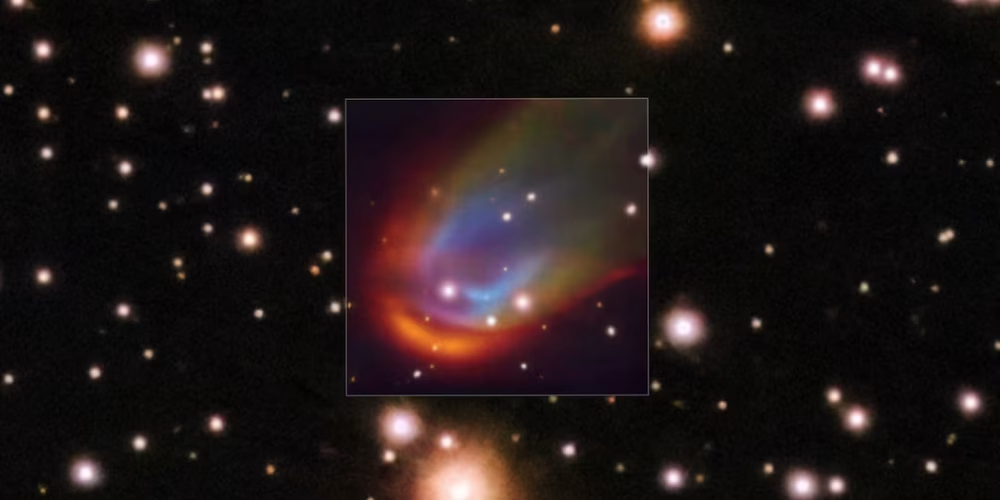
- The shockwave shows distinct colors—red, green and blue—indicating different elements in interstellar gas heated by collision.
- The persistent phenomenon, active for at least a millennium, challenges current understanding of white dwarf outflows.
Astronomers have observed a white dwarf star unleashing a striking, multi-colored shockwave as it moves through space, puzzling researchers about its origin. The compact stellar remnant, around 730 light-years from Earth in the constellation Auriga, is gravitationally bound to a red dwarf companion. Unlike typical systems, this white dwarf lacks a surrounding gas disk yet still produces a vibrant bow shock that glows in red, green and blue hues from heated interstellar gases.
The discovery was made using the European Southern Observatory’s Very Large Telescope, which captured the shockwave’s curved front created as material streaming from the dead star collides with surrounding gas at high speed. The colors visible in images represent specific elements: red for hydrogen, green for nitrogen and blue for oxygen, all excited by the shock’s energy.
Scientists say white dwarfs are Earth-sized stellar embers left after stars like the Sun exhaust their fuel and shed outer layers. In most binary systems, material from a companion forms a disk around the white dwarf, driving familiar outflows. But this system defies expectations: it emits gas without a disk, prompting questions about the mechanism powering the outflow and resulting shock.
The persistent structure indicates the shockwave has been active for at least about 1,000 years, suggesting a long-lasting process rather than a transient event. Researchers remain unclear how the star can expel material at the rates needed to sustain such a shock without the usual accretion disk, making this an intriguing anomaly.
Astrophysicists involved in the study, published in Nature Astronomy, noted that the white dwarf’s strong magnetic field funnels gas from its companion directly, but this alone does not fully explain the observed outflow, leaving room for further investigation.
Beyond its scientific significance, the finding offers a vivid visual reminder that space is dynamic and energized by interactions between stars and their environments. As researchers continue to analyse data, this mysterious system may provide new insights into how binary stars influence cosmic gas and evolve over time.









