

KEY POINTS
- Football’s governing body issued a strong statement supporting Brazilian match official Raphael Claus.
- The political dispute erupted after the American president questioned the referee’s professional integrity.
- The controversy centers on a contested red card suspension involving United States forward Folarin Balogun.
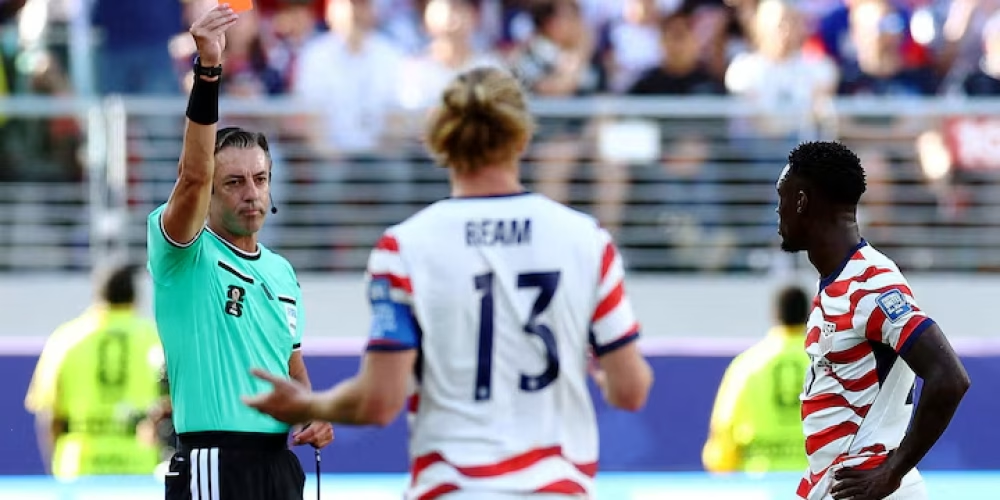
FIFA has formally defended match official Raphael Claus after United States President Donald Trump publicly criticized his refereeing during the 2026 World Cup. The international governing body expressed absolute confidence in the veteran Brazilian official, who faced heavy scrutiny following a controversial red card decision during a recent knockout fixture. The escalation highlights an unprecedented intersection of executive political influence and elite international sports officiating on the global stage.
What You Need to Know
The relationship between political leaders and independent sports organizations has traditionally been governed by a strict boundary intended to prevent external interference. FIFA regulations explicitly demand that member associations operate free from political influence, a principle designed to protect the sporting integrity of international competitions. When a head of state publicly challenges a referee’s decision or implies structural bias without providing evidence, it risks undermining the authority of match officials and destabilizing the regulatory framework that governs global football.
The underlying incident stems from a high-stakes knockout match between the United States and Bosnia and Herzegovina. During the encounter, American forward Folarin Balogun was ejected from the pitch by match referee Raphael Claus following a video assistant referee review for a dangerous challenge. The automatic consequence of a direct dismissal is a one-match suspension, which threatened to sideline one of the host nation’s most impactful attacking players during a crucial subsequent fixture against Belgium. However, in a surprising turn of events, FIFA’s disciplinary committee later opted to suspend the player’s immediate ban, a move that sparked intense debate across the sporting world.
The decision to pause the forward’s suspension immediately drew sharp condemnation from European football authorities and rival federations, who argued that altering standard disciplinary protocols undermines the fairness of the competition. Critics suggested that the governing body had yielded to external pressures, given the immense commercial and national interests tied to the host country’s progression in the tournament. By defending the referee while simultaneously managing the fallout of a suspended ban, football’s leaders find themselves navigating a complex institutional crisis in the middle of a premier global event.
Political Friction and Disciplinary Debates
The situation escalated when President Trump revealed during an oval office press briefing that he had personally communicated with the leadership of football’s governing body to advocate for a formal review of the player’s dismissal. In his public remarks, the American president characterized the initial sending-off as a terrible decision, framing the sequence as an accidental collision rather than a punishable infraction. Trump went further by casting doubt on the background and competence of the Brazilian official, suggesting his past performances warranted closer inspection, though he did not offer specific details to support the assertion.
In swift response to the public criticism, football’s governing body issued an official communique asserting their unwavering support for the match official. The organization stated that Raphael Claus is recognized globally as an elite professional who consistently maintains the highest benchmarks of integrity and operational professionalism. Leaders emphasized that Claus is a trusted member of their top-tier officiating pool, possessing extensive experience with over 600 competitive fixtures managed throughout a highly respected career.
The organizational leadership reinforced this stance by reminding the public and competing nations that respecting match officials is a foundational pillar of the sport. Senior executives noted that without the absolute authority of referees to enforce regulations without fear of political reprisal, the structural viability of international football cannot exist. Due to strict tournament guidelines that prohibit match officials from speaking to media outlets during the competition, Claus remained unavailable to address the political commentary directly.
Despite the intense administrative storm surrounding his eligibility, the American forward was ultimately included in the starting lineup for the subsequent knockout match against Belgium. While the administrative intervention ensured the host nation could field its strongest attacking lineup, it did not alter the competitive outcome on the pitch, as Belgium ultimately secured a decisive victory to eliminate the United States from the tournament. The field result, however, has done little to quiet the broader institutional questions raised by the incident.
Why This Matters
The unprecedented involvement of a sitting American president in a World Cup disciplinary matter signals a dramatic shift in how sports and politics intersect in the modern era. For commercial brands, media networks, and corporate stakeholders invested heavily in the North American sports market, the incident demonstrates how elite sporting events can instantly become lightning rods for geopolitical theater. This reality forces corporate sponsors to carefully evaluate their public alignment with events that are vulnerable to sudden political commentary and regulatory disputes.
For global sports fans, the controversy raises fundamental questions regarding institutional independence in the digital age. If executive interventions from powerful nations are perceived to influence the enforcement of sporting regulations, the perceived fairness of international tournaments could face long-term skepticism. This dynamic could compel sports governing bodies to implement more rigid insulation mechanisms to ensure that disciplinary committees operate entirely independently of host-nation political dynamics in future tournaments.
NCN Analysis
This high-profile dispute illustrates the delicate tightrope that international sports organizations must walk when staging major events within globally dominant nations. While the governing body sought to maintain regulatory order by publicly defending its match official, its simultaneous decision to suspend the player’s ban created a confusing precedent that critics will likely cite for years to come. The compromise appears to have been an attempt to balance administrative rules with the immense commercial pressure of keeping the host nation’s star players on the field.
Moving forward, the international soccer community must address the regulatory vulnerabilities exposed by this incident before the next major tournament cycle begins. Observers should watch closely to see if independent judicial bodies establish clearer boundaries regarding how external appeals are handled during live competitions. If the sport is to maintain its global credibility, the enforcement of disciplinary rules must remain completely decoupled from political diplomacy and executive influence.
The resolution of this administrative crisis will likely redefine the boundaries between executive political power and international sports governance for a generation.
Reported by the NCN Editorial Team









