

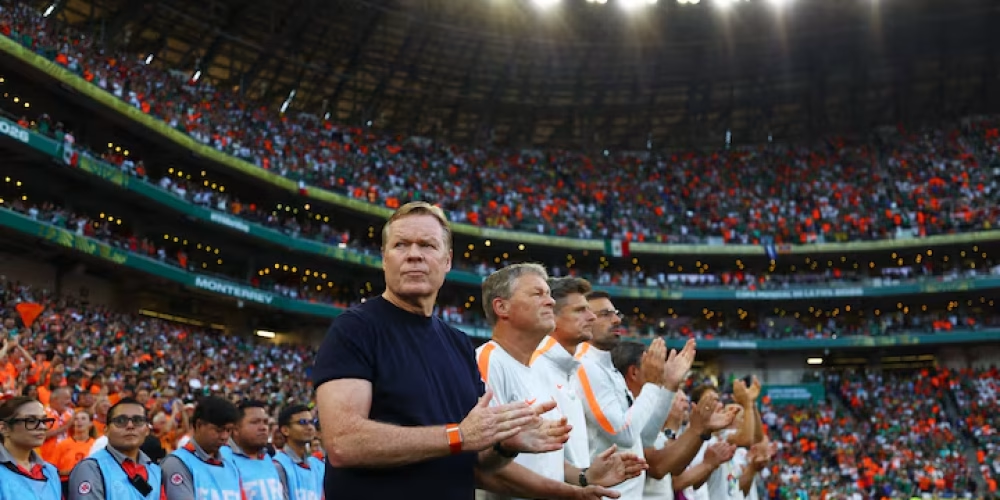
KEY POINTS
- Manager Ronald Koeman robustly defended his conservative tactical decisions following the Netherlands’ penalty shootout elimination by Morocco.
- The Dutch side conceded a dramatic 91st-minute equalizer from Issa Diop, canceling out Cody Gakpo’s emotional second-half opener.
- Critics labeled the tactical setup overly cautious, but Koeman insisted his strategy was designed to counter Morocco’s lethal counter-attacking threat.
The bitter sting of a major tournament elimination frequently places the manager directly under the microscope of public scrutiny. For Netherlands national team boss Ronald Koeman, his strategic choices are facing fierce domestic and international backlash after the Dutch squad crashed out of the 2026 FIFA World Cup in a tense penalty shootout against Morocco on Monday night. Despite holding a precious single-goal lead deep into stoppage time, the Oranje failed to close out the Round of 32 fixture in Guadalupe, prompting a fierce debate regarding whether a more aggressive, traditional attacking philosophy could have secured a place in the quarter-finals.
What You Need to Know
The historical identity of Dutch football is fundamentally rooted in “Total Football”—a fluid, high-pressing, and attack-minded philosophy that prioritizes creative dominance on the pitch. However, during the 2026 tournament cycle, Ronald Koeman has systematically pivoted toward a more pragmatic, defensively secure framework designed to maximize tournament longevity. This stylistic shift has long divided fans in Amsterdam and Rotterdam, who traditionally demand flair alongside victories. When the Netherlands advanced through the group stage with defensive solidity, the critics were largely kept at bay, but Monday’s dramatic collapse reignited long-standing frustrations.
Facing an incredibly disciplined and energetic Moroccan side that captured global attention during their run to the semi-finals four years prior, Koeman opted for a cautious tactical setup. The Dutch team lined up with a compact midfield block meant to suffocate space and neutralize Morocco’s lightning-fast transitional play. While the strategy successfully limited clear-cut opportunities for the opposition for the majority of the match, it also restricted the creative output of the Netherlands’ star forwards, resulting in a cagey, low-scoring affair that relied heavily on individual moments of brilliance rather than sustained attacking pressure.
When Cody Gakpo broke the deadlock in the 72nd minute, it appeared as though Koeman’s conservative blueprint had worked to perfection. However, the decision to drop even deeper and protect the slim margin backfired spectacularly when Morocco’s Issa Diop found the back of the net in the 91st minute. The equalizer completely deflated the Dutch squad, forcing a grueling period of extra time where physical exhaustion took over, ultimately leading to a 3-2 defeat in the subsequent penalty shootout after a 1-1 tie.
Ronald Koeman Tactical Philosophy
In his post-match press conference, a defiant Ronald Koeman strongly pushed back against suggestions that his defensive approach was to blame for the premature World Cup exit. The veteran manager argued that modern international football requires complete structural balance, pointing out that Morocco possesses some of the most dangerous counter-attacking wingers in the world. Koeman stated that opening up the game prematurely would have been tactically reckless, emphasizing that his team had the victory within their grasp until a late lapse in concentration during a set-piece situation allowed Diop to score.
The manager’s defensive adjustments in the final fifteen minutes of regular time have drawn the heaviest criticism from Dutch football pundits. Koeman substituted attacking outlets to introduce an extra defender, a move that critics argue invited unnecessary pressure from a desperate Moroccan side. The tactical retreat allowed Morocco to dictate the tempo of the closing stages, pinned the Dutch defense into their own penalty area, and ultimately created the chaotic environment that led to the tying goal.
Despite the intense scrutiny, veteran defender and team captain Virgil van Dijk publicly supported his manager’s tactical blueprint. Van Dijk noted that the players fully believed in the game plan and executed the defensive instructions effectively for 90 minutes. He insisted that blaming the overarching system was an oversimplification, attributing the loss to minor operational errors on the field and the cruel, unpredictable nature of a penalty shootout rather than an inherently flawed tactical philosophy.
Why This Matters
For soccer fans and tactical analysts across the United States, Ireland, Sweden, and the broader global sports market, the tactical debate surrounding the Netherlands highlights the perpetual conflict between entertainment and pragmatism in elite sports. As the World Cup expands and the physical demands on elite players reach unprecedented levels, conservative coaching strategies are becoming more prevalent. This match serves as a case study for sports programs and modern coaches worldwide on the inherent risks of adopting a defensive posture to preserve a narrow lead in high-stakes knockout environments.
Additionally, the fallout from this match has significant implications for how international football associations evaluate coaching performances. In an era where data analytics and structural rigidity frequently override individual flair, the public backlash in the Netherlands demonstrates that fanbases still deeply care about the aesthetic style of play. For commercial broadcasters and tournament organizers in North America, the departure of a high-profile, traditionally entertaining team like the Netherlands alters the viewership dynamics for the remainder of the tournament.
NCN Analysis
From our editorial viewpoint, Ronald Koeman’s defensive approach was a calculated gamble that simply ran out of time. While it is easy to criticize a defensive retreat after a late equalizer, the reality is that tactical pragmatism has won numerous World Cup titles in recent history. Koeman’s primary error was not the initial game plan, but rather his inability to adapt when his players began showing signs of severe physical fatigue late in the second half, leaving them vulnerable to Morocco’s relentless aerial assault.
Looking ahead, the Royal Dutch Football Association (KNVB) faces a critical decision regarding the future of the national team’s leadership. Koeman’s contract and his rigid tactical philosophy will undergo an intense review in the coming weeks. Football fans should watch closely to see if the KNVB demands a return to the nation’s historic attacking roots or if they will continue down this pragmatic path as they prepare for the next European Championship qualification cycle.
The line between tactical genius and absolute failure in international football remains razor-thin, and a single minute can redefine a manager’s entire legacy.
Reported by the NCN Editorial Team









