

KEY POINTS
- The New York Knicks captured a commanding 3-0 series lead in the Eastern Conference finals after defeating the Cleveland Cavaliers 121-108 in Game 3.
- Star guard Jalen Brunson led all scorers with 30 points, extending New York’s historic postseason winning streak to ten consecutive games.
- Facing immediate postseason elimination, the Cavaliers are searching for strategic answers to counter New York’s highly efficient offensive perimeter execution.
The New York Knicks moved within a single victory of their first championship series appearance in twenty-seven years by dominating the Cleveland Cavaliers on their home floor over the weekend. Driven by an incredibly efficient offensive performance and an uncompromising defensive identity, the visiting squad controlled the tempo from the opening tip-off to secure a decisive double-digit victory. The dominant triumph extends New York’s current unblemished playoff run, pushing the Ohio-based franchise to the absolute brink of elimination in the best-of-seven series.
What You Need To Know
The historic significance of the current postseason trajectory cannot be overstated for one of the league’s most passionate fan bases. The Manhattan-based franchise has not advanced to the final stage of professional basketball since 1999, an era defined by physical defensive battles and the legendary interior presence of Patrick Ewing. Furthermore, the club has not secured a Larry O’Brien championship trophy since 1973, creating decades of intense longing for a return to the sport’s absolute mountaintop.
This year’s roster layout represents a dramatic departure from previous iterations, constructed through deliberate front-office acquisitions designed to maximize modern positional versatility and perimeter shooting. The team entered the Eastern Conference finals following a dominant performance through the opening two rounds of the postseason, including an impressive sweep of the Philadelphia 76ers. This sustained success has transformed the historical basketball Mecca of Madison Square Garden into an epicenter of cultural excitement across the northeastern United States.
Conversely, the opposing roster underwent its own dramatic transformation during the preceding offseason periods to establish a championship-caliber core. The inclusion of high-profile veteran playmakers alongside ascending interior talents was intended to propel the franchise back to the heights achieved during their historic title runs in the previous decade. Navigating a challenging postseason path through the early rounds, the Ohio team must now overcome an unprecedented historical deficit, as no franchise in league history has ever successfully rallied from a 3-0 series deficit.
Brunson Core Ignites Offense to Silence Rocket Arena Crowd
The critical Game 3 showdown unfolded at Rocket Arena in Cleveland, where a highly enthusiastic home crowd quickly fell silent as the visiting side established structural dominance. The visitors executed their half-court sets with surgical precision, concluding the evening with an exceptional 55.8% shooting efficiency from the field. This offensive clinic was supplemented by disciplined perimeter shooting, as the squad knocked down 11 three-pointers and converted an outstanding 24 of 27 opportunities from the free-throw line to prevent any realistic threat of a second-half comeback.
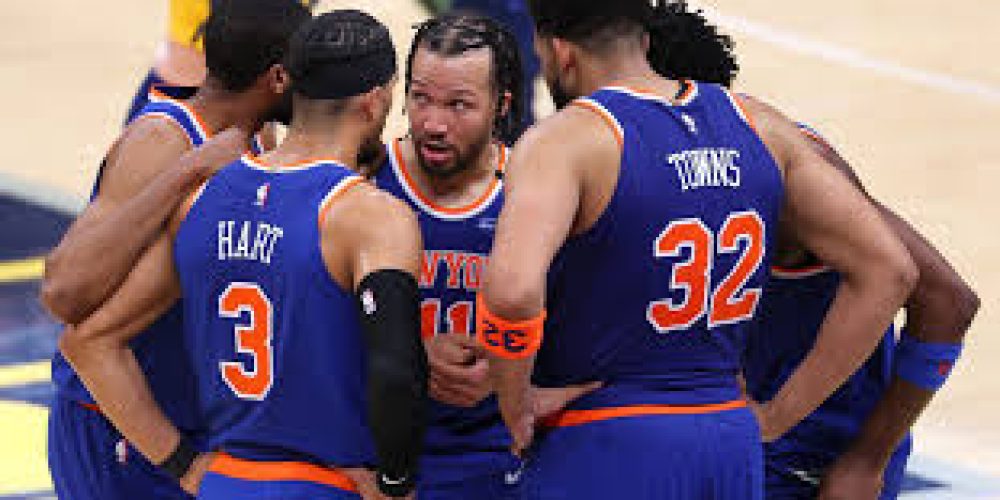
At the center of this offensive masterpiece was premier playmaker Jalen Brunson, who continuously dismantled the opposing perimeter defense to record a game-high 30 points alongside 6 assists. The dynamic guard received substantial structural support from wide forward Mikal Bridges, who delivered an incredibly efficient 22-point performance on an outstanding 11-of-15 shooting display. Meanwhile, forward OG Anunoby anchor-dropped 21 points while providing elite individual defense against the home side’s primary scoring options, demonstrating complete physical recovery from earlier lower-body issues.
The interior presence of Karl-Anthony Towns provided the essential connective tissue for the dominant performance, with the versatile big man contributing a well-rounded stat line of 13 points, 8 rebounds, and 7 assists. This multi-faceted execution allowed the visitors to protect their lead through transitional moments, neutralizing the offensive output of home team center Evan Mobley, who recorded 24 points, and guard Donovan Mitchell, who finished with 23 points. Despite supplementary veteran contributions from perimeter asset James Harden, who added 19 points, the home side struggled immensely with ball security, registering high turnover metrics that fueled the opponent’s fast-break opportunities.
Following the conclusion of the contest, the triumphant locker room maintained a remarkably disciplined, low-key perspective regarding their historic positioning. While ecstatic fans across New York celebrated the imminent prospect of a series sweep, the players echoed a unified message of sustained concentration ahead of Game 4. The coaching staff emphasized that historical milestones mean absolutely nothing until the definitive fourth victory is secured, urging the roster to treat the upcoming matchup with the exact same tactical intensity that initiated their ten-game postseason winning streak.
Why This Matters
The structural revival of a premier sports institution creates monumental commercial waves across the sports entertainment landscape of the United States. As one of the largest economic engines in professional sports, a deep postseason run by a metropolitan franchise drives historic television viewership metrics, unprecedented consumer merchandise spending, and elevated advertising valuations for major national broadcasting networks. The cultural resonance of basketball success in Manhattan attracts casual sports fans into the viewing audience, expanding the general market share of professional basketball during the early summer television window.
Additionally, the competitive evolution of this rivalry provides fascinating strategic case studies for basketball academies and domestic development programs across North America. The specific roster construction models deployed by both front offices highlight a broader tactical shift toward complete spatial utilization and defensive adaptability over traditional positional restrictions. Watching these advanced philosophies clash on a national stage offers invaluable educational insights for young athletes and coaches who strive to replicate elite basketball execution within local high school and collegiate environments.
NCN Analysis
The current technical superiority displayed by New York stems directly from their elite, unselfish floor spacing and complete physical synchronization at both ends of the hardwood. By deploying multiple playmakers who possess the ability to both break down defenders off the dribble and execute precise perimeter passes, the offensive unit forces opponents into constant, exhausting defensive rotations. This collective fluidity creates a highly sustainable style of play that mitigates individual fatigue, making their current ten-game postseason streak a natural result of superior structural organization rather than individual hot streaks.
For the cornered Ohio franchise, the path toward extending the series requires an immediate, radical adjustment regarding how they defend high-screen actions involving the opponent’s premier guard. Continuing to allow primary ball-handlers to dictate isolation scenarios against compromised perimeter defenders will inevitably yield identical results in the upcoming match. The coaching staff must implement aggressive trapping schemes and rely heavily on active interior help-side defense to force peripheral players into taking high-pressure shots, testing the depth of the opponent’s rotation under absolute elimination pressure.
The ultimate takeaway from this high-stakes postseason encounter is that championship execution requires an unwavering commitment to operational consistency, regardless of historical expectations or hostile external environments.
Reported by the NCN Editorial Team









