KEY POINTS
- Prime Minister Christopher Luxon stated that the proposed liquefied natural gas (LNG) import terminal will only proceed if the final business case demonstrates a solid economic return.
- Rising global energy prices, exacerbated by ongoing conflict in the Middle East, have significantly altered the financial landscape of the project since its initial proposal in 2025.
- The government is currently in the procurement stage with multiple international bidders, but a final “brutal” decision is expected by mid-2026 based purely on cost-benefit analysis.
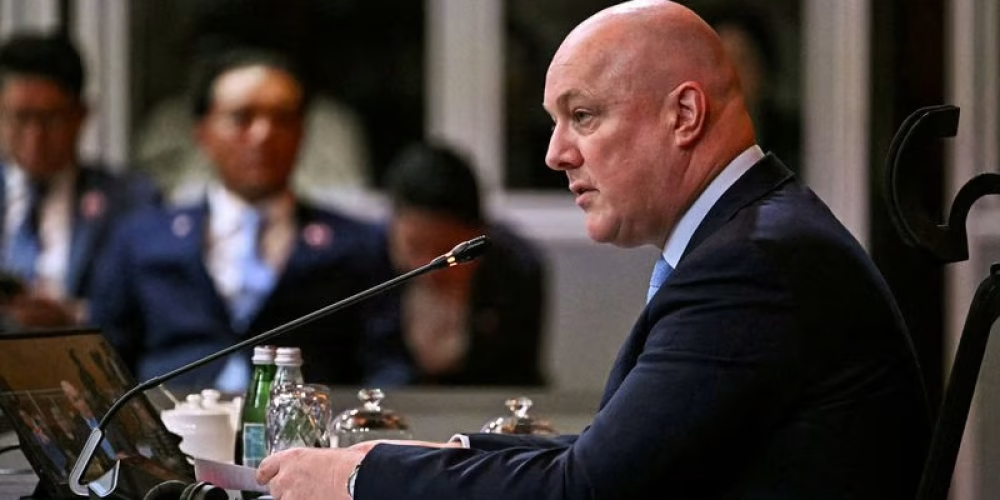
New Zealand Prime Minister Christopher Luxon has signaled a potential shift in the government’s energy strategy, warning that the planned NZ$1 billion LNG import terminal could be scrapped if the numbers do not “stack up.” Speaking during a series of media briefings on Monday, Luxon emphasized that while energy security remains a top priority, the government will not sign off on the project unless it proves to be commercially attractive. This cautious stance comes as the nation awaits a comprehensive fuel supply update amid a volatile global market.
The proposed terminal, slated for Taranaki on the North Island, was originally envisioned as a critical “insurance policy” against electricity price spikes during dry years when hydropower generation is low. By allowing New Zealand to import gas only when domestic supplies are tight, the facility was expected to save consumers upwards of $265 million annually. However, the economic feasibility of this model is now under intense scrutiny. Recent reports suggest that elevated commodity prices, driven by the blockade of the Strait of Hormuz and regional instability, have made the cost of importing gas far more expensive than previously modeled.
The procurement process is currently in a competitive phase, with the government reviewing a shortlist of international proposals. Energy Minister Simon Watts had previously indicated that a contract could be signed by the middle of 2026, aiming for an operational date in 2027 or 2028. Despite this timeline, the Prime Minister’s recent comments reflect a “brutal” approach to the final decision. Luxon clarified that the administration is looking for a clear economic return and will not use a “cash bazooka” to subsidize a project that fails to be self-sustaining or competitive in the current high-inflation environment.
Political tension surrounding the project is also mounting as the November 2026 general election approaches. The opposition Labour Party has already pledged to scrap the LNG terminal if they return to power, arguing that the country should instead focus on its abundant renewable energy resources. Critics of the terminal suggest that over-reliance on imported LNG could permanently link New Zealand’s domestic power prices to volatile global markets, potentially increasing costs for households in the long run. The government, however, maintains that gas is a necessary transition fuel to support the grid as renewable capacity grows.
Beyond the LNG terminal, the Prime Minister addressed broader concerns regarding New Zealand’s fuel resilience. He noted that while the global fuel-price shock is hitting families hard, the country remains in “good shape” compared to its neighbors, with significant diesel stocks currently on the water or unloading at ports. The government is also considering a four-level fuel alert system to manage potential shortages. Luxon reiterated that any additional support for citizens would be targeted specifically at those in genuine need to avoid further fueling inflation.
As the mid-2026 deadline for the contract signing draws closer, the energy sector is watching for any signs of a formal delay or cancellation. The decision rests on whether the shortlisted bidders can present a design and supply chain that can withstand the current geopolitical pressures. For now, the future of New Zealand’s energy infrastructure remains tethered to a shifting global economy, with the Prime Minister insisting that fiscal responsibility will take precedence over previously settled infrastructure plans.