

KEY POINTS
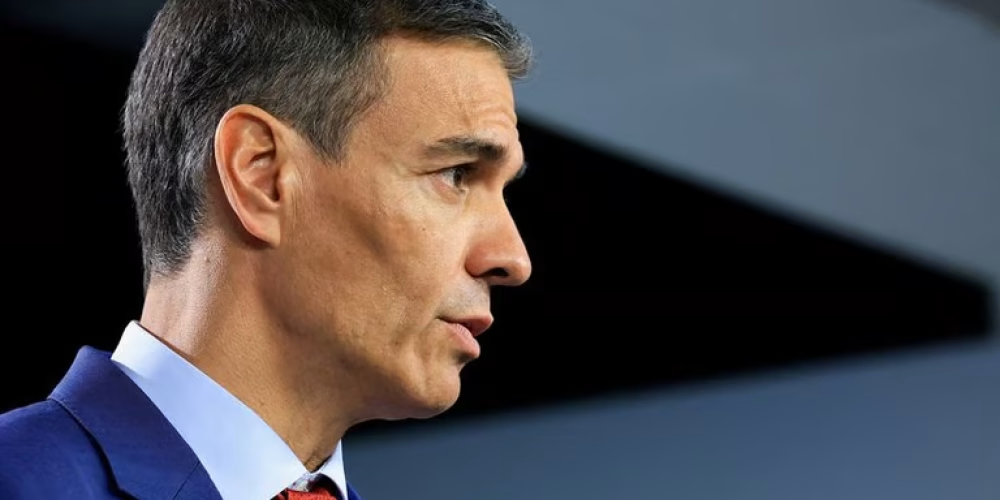
- Prime Minister Pedro Sánchez reaffirmed Spain’s dedication to NATO and European Union security frameworks during a high-profile summit in Madrid.
- The Spanish government announced plans to accelerate defense spending to meet international benchmarks amid shifting geopolitical tensions across the continent.
- European leaders discussed new strategies for maritime security and the protection of critical subsea infrastructure against emerging aerial and naval threats.
The geopolitical landscape of Southern Europe underwent a significant recalibration this week as Spanish Prime Minister Pedro Sánchez hosted a series of high-level meetings with key representatives from NATO and the European Union. Addressing a joint session in Madrid, Sánchez emphasized that Spain is prepared to take on a more robust leadership role within the Western alliance. This shift in tone reflects a broader trend among European nations seeking to solidify their collective defense capabilities in response to increasing regional volatility and the disruption of traditional security norms.
Central to the discussions was Spain’s commitment to a significant increase in its national defense budget. For several years, the country has faced pressure from international partners to align its military spending with the two-percent-of-GDP target established by NATO. Sánchez indicated that the current administration is now fast-tracking these investments, focusing specifically on the modernization of the Spanish Air Force and the enhancement of its naval surveillance capabilities. These upgrades are viewed as essential for maintaining the security of the Mediterranean, which remains a vital corridor for global trade and energy supplies.
The summit also addressed the growing concern over the vulnerability of European infrastructure. Recent incidents involving drone activity and the potential targeting of underwater telecommunications cables have placed European leaders on high alert. The Madrid talks resulted in a preliminary agreement to increase joint naval patrols and share real-time intelligence on “unidentified aerial phenomena” near sensitive military installations. This coordinated approach is intended to provide a credible deterrent and ensure that European nations can react swiftly to any interference with their digital or physical borders.
Beyond military hardware, the diplomatic dialogue touched on the internal stability of the European Union. Sánchez utilized the platform to advocate for greater economic integration and the streamlining of decision-making processes regarding foreign policy. By presenting a more unified front, European leaders hope to exert more influence on global affairs and reduce their dependence on external security guarantees. This push for “strategic autonomy” has gained significant traction among Mediterranean nations, who often find themselves on the frontline of regional migration and security challenges.
The response from fellow European leaders was largely supportive, with many praising Spain’s proactive stance. However, the domestic political environment remains a factor that could influence the speed of these reforms. While the current administration holds a clear vision for international cooperation, the allocation of billions of euros toward military spending will require careful negotiation with regional partners and opposition parties. Nevertheless, the momentum generated by the summit suggests a clear mandate for Spain to evolve its role from a secondary player to a central pillar of European security.
As the continent continues to navigate a period of profound change, the outcomes of the Madrid summit provide a blueprint for a more resilient and self-reliant Europe. The focus now moves to the implementation of these defensive upgrades and the continued coordination of regional military exercises. With a renewed sense of purpose and a commitment to increased funding, Spain appears ready to navigate the complexities of the modern security era alongside its closest allies.









