

KEY POINTS
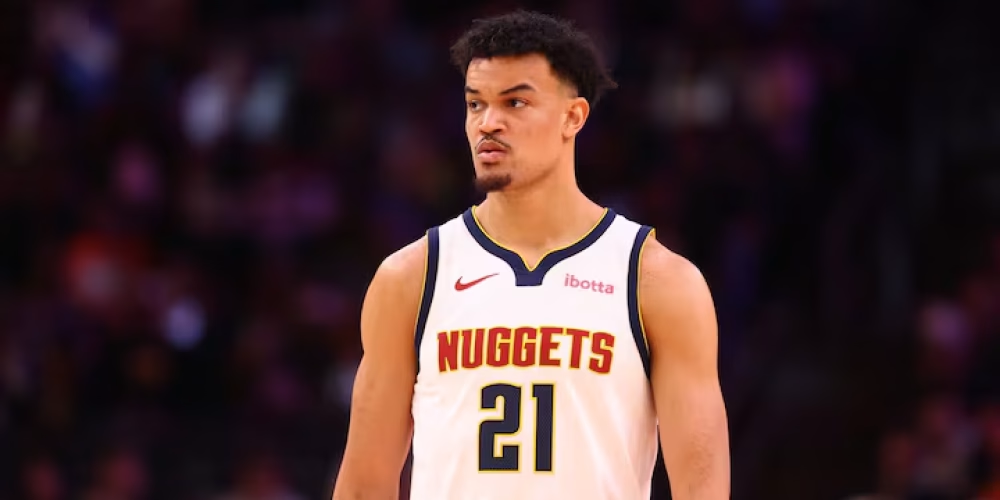
- The Denver Nuggets matched a two-year, $12 million offer sheet from the Western Conference rival Oklahoma City Thunder to keep forward Spencer Jones in Denver.
- Retaining the restricted free agent causes Denver’s estimated luxury tax obligation to surge from $36 million to $68 million, pushing the franchise above the high-penalty second apron.
- Jones emerged as a pivotal rotational piece for Denver last season, starting 37 games while posting strong perimeter shooting percentages after transitioning from a two-way contract.
The Denver Nuggets have taken a significant financial stand to keep their young core intact, matching a two-year, $12 million offer sheet extended to restricted free agent forward Spencer Jones by the Oklahoma City Thunder. Denver finalized the decision shortly before the Sunday night deadline, ensuring the versatile 25-year-old contributor remains locked into the team’s rotation rather than joining a key rival in the Western Conference standings.
What You Need to Know
Spencer Jones’ rise within the Denver organization highlights one of the franchise’s most successful developmental journeys in recent seasons. After going unselected in the 2024 NBA Draft following a five-year collegiate tenure at Stanford, the 6-foot-7 forward originally entered the organization on a two-way contract. While his rookie campaign saw minimal floor time, his second professional season saw a dramatic expansion in his operational role as injuries forced structural adjustments across Denver’s forward rotation.
During the 2025–26 regular season, Jones appeared in 64 games and earned 37 starting assignments while filling in capably for starters dealing with nagging injuries. He recorded averages of 5.5 points and 3.3 rebounds in 22.1 minutes per contest, demonstrating reliable efficiency by converting over 50% of his field goals and making 39.6% of his attempts from beyond the three-point arc. His defensive adaptability and spot-up capability led Denver management to convert his two-way agreement into a standard NBA contract midway through the year.
Recognizing his value as a flexible two-way asset, the Oklahoma City Thunder attempted to pry Jones away over the weekend by leveraging a fully guaranteed two-year contract offer. Oklahoma City targeted Jones to shore up their own wing rotation following roster adjustments earlier in the offseason, leaving Denver facing a strict 48-hour timeline to either match the terms or allow the young wing to depart without asset compensation.
Financial Fall-Out Pushes Nuggets Past Luxury Tax Thresholds
Deciding to match the $12 million contract required a heavy financial commitment from Denver’s front office under current league salary cap mechanics. Because the franchise was already operating in restricted cap territory, adding Jones’ contract structure increases Denver’s projected luxury tax penalty by an estimated $32 million, driving their total tax bill up to roughly $68 million for the upcoming season.
Furthermore, matching the offer sheet officially pushes Denver past the restrictive second tax apron threshold. Operating above the second apron restricts administrative team operations, including restrictions on bundling contracts in trade scenarios, sending cash in player transactions, and using specific trade exceptions. To relieve these escalating financial penalties, league insiders suggest Denver management may explore mid-season trade arrangements to trim overall team payroll before tax calculations are finalized at the conclusion of the regular season.
The decision also impacts how Denver navigates remaining off-season priorities, including the ongoing restricted free agency of forward Peyton Watson. With Jones officially under contract through 2028, Denver retains his Early Bird Rights and holds trade-veto power rights for the player throughout the 2026–27 campaign as dictated by league offer sheet regulations.
What This Means for Americans
For American basketball fans and NBA followers tracking Western Conference parity, Denver’s high-stakes maneuver underscores how aggressively contenders will spend to protect roster depth. As franchise front offices adjust to harsh luxury tax rules introduced under the latest collective bargaining agreement, mid-tier contract decisions now carry massive financial consequences that directly shape championship windows.
The rivalry between Denver and Oklahoma City gains an extra layer of competitive friction as a result of this free agency standoff. Oklahoma City’s attempt to draw an impactful role player away from a primary conference rival demonstrates how top-tier teams actively utilize cap space to disrupt opponents, forcing competing front offices into difficult fiscal tradeoffs.
NCN Analysis
Denver’s choice to absorb a severe luxury tax penalty to retain Spencer Jones signals that winning takes immediate priority over short-term cap optimization. In today’s NBA environment, finding dependable 3-and-D wing players who fit seamlessly alongside primary star creators without demanding high usage is exceptionally difficult. Letting a proven 25-year-old rotation player walk to a main Western Conference rival would have severely compromised Denver’s functional depth behind their primary frontline.
However, operating inside the second apron forces severe long-term constraints on front office flexibility. With significant roster costs already committed to core starters and future contract negotiations looming for supporting talent, Denver’s executive leadership will need to execute clever roster moves over the next twelve months to avoid compounding financial penalties. Matching this offer sheet preserves vital championship depth today, but it ensures complex trade negotiations lie ahead during the regular season.
By prioritizing on-court production over tax savings, Denver reaffirmed its commitment to staying in immediate championship contention.
Reported by the NCN Editorial Team









