

KEY POINTS
- Severe thunderstorms and regional lightning safety protocols forced the Spanish national team to completely abandon their final outdoor training session before the championship match.
- Tournament organizers confirmed that no makeup field sessions will be permitted for the European champions prior to their highly anticipated clash with Argentina.
- Reigning champions Argentina also faced logistical hurdles, with their primary practice session delayed by nearly an hour due to the same heavy weather system.
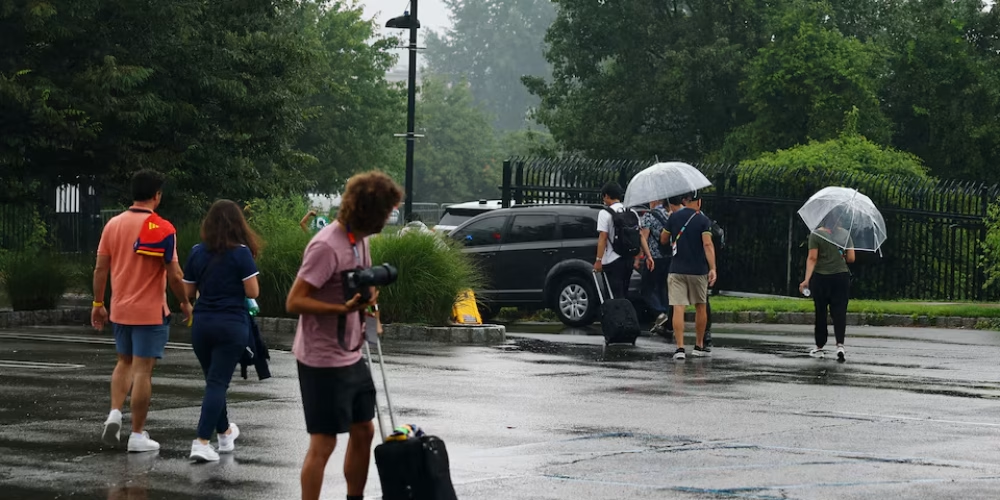
Severe thunderstorms in the northeastern United States have severely disrupted the final preparations for the FIFA World Cup final, forcing Spain to cancel its last outdoor tactical session. The abrupt scheduling disruption occurred on Saturday after heavy rain and lighting warnings swept across the New York and New Jersey metropolitan areas, triggering strict regional safety mandates. With the highly anticipated final against Argentina looming at MetLife Stadium, the unexpected weather setback has injected an element of unpredictability into the closing hours of soccer’s premier tournament.
What You Need to Know
The cancellation highlights the strict athletic safety regulations enforced across North American sporting venues during severe weather events. Under standard United States outdoor tournament protocol, all field activities must be immediately suspended if a lightning strike is detected within an eight-mile radius of the facility. Once a suspension is called, officials must wait a mandatory 30 minutes following the last recorded lightning flash before allowing athletes to return to the playing surface.
For the Spanish squad, who had traveled to the Melanie Lane Training Ground in New Jersey for their final high-intensity tune-up, the weather window proved entirely uncooperative. A steady downpour throughout the morning quickly escalated into a severe thunderstorm warning, prompting the Royal Spanish Football Federation to cooperate with safety executives. Rather than risking prolonged delays standing in the rain, the team management elected to call off the outdoor segment entirely after waiting roughly 40 minutes for conditions to clear.
Compounding the logistical headache for the European champions, FIFA officials explicitly stated that no alternative training slots would be arranged before the final match. This policy ensures scheduling fairness across the tournament infrastructure but leaves the affected squad without a final opportunity to practice set pieces and tactical shapes on an actual pitch. Instead, the team had to pivot immediately to generalized conditioning work inside their private team facility.
Pre-Final Chaos at the Training Grounds
The adverse weather conditions did not spare Spain’s direct opponents, creating a chaotic afternoon of adjustments for both finalists. While the Spanish team was forced entirely inside for an impromptu gym session, the Argentine national team faced a similar threat at their training base in Morristown, New Jersey. The South American champions managed to avoid a total cancellation, but their scheduled midday practice session was pushed back by 45 minutes as staff monitored the moving storm cells.
This unexpected disruption is particularly striking given the contrasting tactical paths both teams took to reach the showcase event. Spain cruised into the final on the back of a dominant, structured performance against France, highlighted by clinical attacking play from young winger Lamine Yamal and fullback Pedro Porro. Having relied heavily on rhythmic passing and precise spacing throughout their tournament run, losing their final outdoor familiarity session creates an unwelcome variable for head coach Luis de la Fuente.
Conversely, Argentina arrived at the final match following a grueling, emotionally draining semifinal comeback against England, settled by a late winner from Lautaro Martinez. The extra 45-minute delay on the practice field did little to dampen the focus of Lionel Messi’s squad, who are chasing historical back-to-back global titles. The contrast in how both teams navigated the stormy Saturday afternoon added an extra layer of drama to an already intense international rivalry.
Why This Matters
For American sports fans, local municipalities, and stadium operations staff, the storm disruptions underline the massive logistical vulnerabilities inherent in hosting mega-events across expansive geographic regions. The severe weather system did not just affect the players on the grass; it caused widespread travel delays throughout the tri-state area. High-profile dignitaries, corporate sponsors, and thousands of international fans arriving at regional airports faced significant disruptions, illustrating how unpredictable summer weather can instantly complicate multi-billion-dollar sports entertainment operations.
Furthermore, the rainstorms arrived during a week when the eastern United States was already grappling with heavy atmospheric haze carried down from Canadian wildfires. In a strange twist of environmental luck, meteorologists noted that the heavy rainfall actually performed a vital public health service by washing away dense layers of lingering smoke. For the millions of viewers tuning in domestically, and the 80,000 spectators packed into the East Rutherford stadium, the severe storms effectively cleared the air, ensuring far safer breathing conditions for the final match despite the initial training chaos.
NCN Analysis
The total loss of an outdoor session puts Spain at a slight psychological disadvantage heading into the opening whistle. Elite international soccer operates on incredibly fine margins, and coaches value the final pre-match walk-through to solidify defensive positioning and build muscle memory for specific set-piece routines. Forcing world-class players to substitute crucial tactical field work with basic indoor stretching could lead to a cagey, less organized defensive start from the Spanish side during the opening exchanges.
However, the rapid clearing of the storm system ensures that the pitch conditions at MetLife Stadium will remain optimal for a fast-paced game. Both squads possess immense technical talent, and the dissipation of the regional wildfire smoke means the athletes will be performing at peak physical capacity without environmental strain. Fans should watch closely to see if Spain shows early signs of tactical rustiness, or if Argentina can immediately exploit their opponent’s disrupted preparation window.
The unpredictable summer elements have set the stage for a dramatic clash where adaptability off the pitch is just as vital as talent on it.
Reported by the NCN Editorial Team









