

KEY POINTS
- FIFA Chief of Global Football Development Arsene Wenger announced that the mandatory cooling periods will undergo a comprehensive post-tournament review due to widespread criticism.
- Soccer officials insist that the implemented breaks did not affect match results or disrupt the overall flow of play, despite strong complaints from several prominent national team managers.
- Critics and broadcasting analysts suggest the rule was less about player welfare and more focused on creating highly lucrative windows for commercial television advertising.
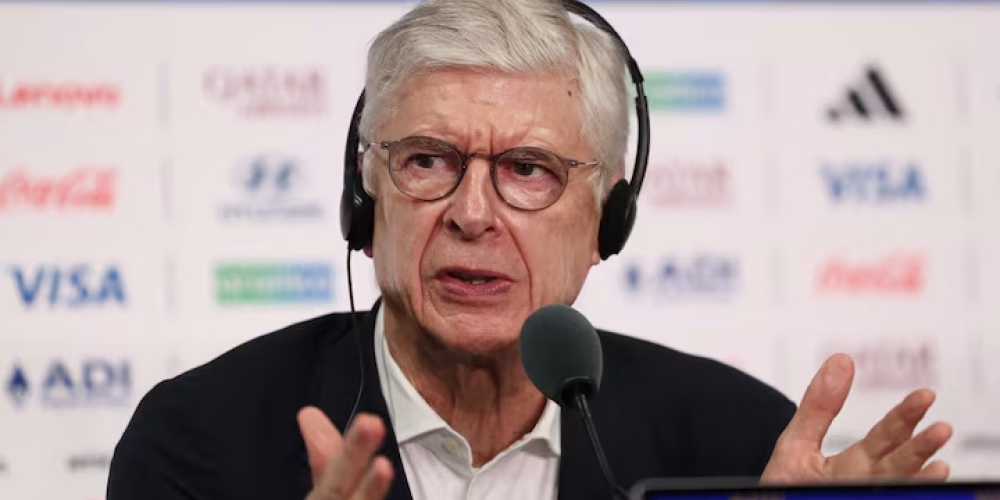
The mandatory World Cup hydration breaks implemented during this summer’s tournament will undergo a rigorous review following intense criticism from fans, television viewers, and national team managers. Speaking at a media briefing in East Rutherford, New Jersey, ahead of the highly anticipated final between Spain and Argentina, FIFA Chief of Global Football Development Arsene Wenger confirmed that soccer’s governing body plans to thoroughly analyze the data before deciding whether to continue the policy in future international tournaments. For American fans experiencing the expanded 48-team tournament format across North America for the first time, this operational pivot marks a significant moment in the intersection of tournament logistics, television broadcasting, and the traditional flow of international soccer.
What You Need to Know
The implementation of mandatory hydration breaks represented a radical departure from traditional soccer governance rules. Previously, cooling breaks were entirely discretionary, allowing match referees to pause play only when local environmental conditions reached hazardous heat and humidity levels. Under that classic framework, tournament organizers utilized specific thermal indices to determine whether a brief intermission was necessary to protect the physical well-being of the athletes on the pitch.
However, for the current tournament cycle, soccer officials decided to standardize the procedure by enforcing a mandatory three-minute stoppage approximately 22 minutes into each half across all 104 tournament fixtures. This sweeping policy applied to every single game, completely ignoring the specific climate, geographical location, or venue infrastructure. Even matches contested in mild temperatures or inside state-of-the-art stadiums featuring fully closed roofs and advanced internal climate-control systems were subjected to the exact same interruptions.
The rationale presented by soccer executives centered heavily on player welfare and uniform competitive conditions. Because elite modern soccer requires immense physical exertion—with midfielders and wingers routinely covering more than seven miles per match while executing high-intensity sprints—governing bodies argued that standardized rest periods would offer a fair environment for every competing nation. Yet, the rigid application of the rule quickly sparked an intense global debate regarding the preservation of the game’s historic continuity.
The Contradiction of Mandatory Cooling Breaks
The absolute uniformity of the policy created several bizarre scenes throughout the group and knockout stages that drew immediate scrutiny from soccer purists. In one notable instance, players were forced to halt play during a match where the ambient temperature was a chilly 16 degrees Celsius (approximately 61 degrees Fahrenheit). Television cameras captured athletes standing around in the cool air, drinking water they clearly did not require, while the natural momentum of a highly competitive international match was completely extinguished by administrative mandate.
This disruption of competitive rhythm became a massive talking point among tactical experts and team staff. Prominent managers openly complained that these arbitrary intermissions essentially divided a traditional 90-minute game into four distinct quarters, altering how teams managed fatigue and tactical adjustments. While some managers, such as the United States leadership, adapted by utilizing laptops to display immediate tactical corrections to huddled players, others argued that the stoppages unfairly rescued defensive teams under sustained pressure. A team that had successfully forced multiple consecutive corner kicks suddenly found its attacking advantage erased, giving the defending side a free opportunity to rest and reorganize its lines.
Despite the vocal opposition from coaching staffs who felt the cultural essence of the sport was being compromised, executive leadership defended the operational outcomes. Officials maintained that a meticulous examination of technical metrics indicated the breaks had no measurable impact on final scores or the organic flow of the tournament. The official stance emphasizes that the historically high intensity observed in the latter stages of matches might actually be a direct positive consequence of these brief mid-half periods of rest.
Why This Matters
For the sporting public and commercial markets in the United States, the controversy surrounding these mid-half intermissions extends far beyond tactical debates on the pitch. The American sports landscape is traditionally built around structured television timeouts, making the sudden introduction of predictable breaks in soccer an immediate focal point for major media networks. Critics quickly pointed out that these three-minute windows provided broadcasters with a golden opportunity to insert highly profitable commercial advertising into a sport that historically prides itself on 45 minutes of uninterrupted action.
The financial implications of these television windows are astronomical. Media industry experts estimate that a standard 30-second commercial spot during tournament broadcasts in the United States commands between $200,000 and $300,000. During the high-stakes knockout rounds, or when the United States national team was actively drawing massive domestic viewing audiences, those advertising rates skyrocketed to upwards of $750,000 per spot. Consequently, a mandatory three-minute pause allowed broadcasting partners to capture millions of dollars in unexpected revenue, fueling skepticism that the policy was driven by corporate financial interests rather than a pure commitment to athlete safety.
NCN Analysis
The upcoming post-tournament review will serve as a critical crossroads for how international soccer balances corporate commercialization with athletic tradition. While executive leadership will undoubtedly look at medical data regarding player recovery and heat exhaustion, the overwhelming negative feedback from the global fanbase cannot be easily dismissed. Soccer fans across regions like Ireland, Sweden, and the United States have voiced clear frustration with any regulatory changes that make the sport mirror the stop-and-start nature of traditional American gridiron football or basketball.
Moving forward, the governing body is highly likely to retreat from its absolute, mandatory approach and return to a modified version of the previous discretionary system. Expect future tournament regulations to restrict cooling breaks strictly to open-air venues experiencing documented extreme heat indexes. By decoupling these player welfare measures from climate-controlled, covered stadiums, soccer authorities can appease corporate broadcasting partners without permanently alienating the traditional fan base that demands an uninterrupted, fast-flowing sport.
The ultimate fate of mid-game intermissions will depend on whether soccer executives value broadcasting revenue over the historic integrity of the game’s clock.
Reported by the NCN Editorial Team









