

KEY POINTS
- Colombia successfully marked their return to international soccer’s premier tournament with an opening 3-1 victory over Uzbekistan.
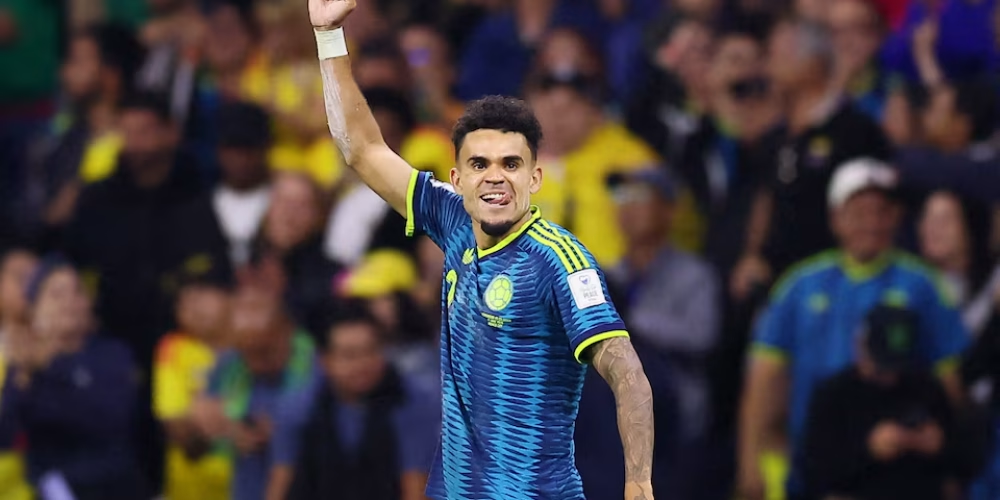
- Winger Luis Díaz commanded the pitch at the Estadio Azteca, racking up an assist and the crucial tiebreaking goal.
- With Portugal held to a surprise draw by DR Congo, Colombia flies directly to the top of the Group K standings.
Colombia’s national football team launched their highly anticipated tournament campaign with a commanding 3-1 victory over debutants Uzbekistan, propelled by a masterclass performance from superstar Luis Díaz. The high-stakes fixture captivated an electric crowd at the Estadio Azteca, signaling Colombia’s intent to dominate their group stage matches. For American soccer enthusiasts witnessing the tactical depth of South American giants, the energetic clash offered a brilliant preview of the elite competition expanding across North America.
What You Need to Know
Colombia’s return to the global football stage carries immense emotional weight after the disappointment of missing out on the previous winter showcase in Qatar. Historically respected for their fluid, attacking identity and defensive grit, Los Cafeteros have consistently produced world-class talents capable of altering matches in a single moment. Under the technical guidance of manager Nestor Lorenzo, the South American powerhouse completed a rigorous qualifying cycle, famously downing regional titans Brazil and Argentina to cement their reputation.
Uzbekistan, conversely, arrived in Mexico City to make their historic debut on soccer’s most visible stage. Led by veteran Italian strategist Fabio Cannavaro, the White Wolves earned their tournament ticket through a highly impressive Asian qualifying run, losing only once in sixteen matches to finish right behind Iran. Known for deep tactical discipline and an organized low block, the Asian newcomers were viewed as a dangerous opening fixture capable of exploiting any overconfident opponent.
The encounter at the Estadio Azteca represented a classic clash of styles: Colombia’s relentless lateral distribution and high-octane winger play against Uzbekistan’s stubborn five-man defensive wall. With a fiercely pro-Colombian crowd of over 80,000 filling the historic venue, the atmospheric pressure amplified the tactical stakes for both national teams.
Colombia Defeats Stubborn Uzbekistan at Estadio Azteca
From the opening whistle, Colombia dictated the tempo, maintaining significant possession while testing the boundaries of Uzbekistan’s defensive perimeter. The initial breakthrough required tactical patience, as the debutants limited spaces efficiently, even surviving a scare when a low strike from Luis Díaz ricocheted directly off the post. The deadlock finally cracked in the 40th minute when Díaz delivered a perfectly weighted pass over the defensive line, allowing Daniel Muñoz to track the ball and smash a first-time volley into the net.
Uzbekistan responded with admirable resilience in the second half, gradually exploiting Colombia’s defensive transition to spark a historic comeback moment. In the 60th minute, a firm volley from Eldor Shomurodov was spilled by Colombian keeper Camilo Vargas, leaving Abbosbek Fayzullaev to react quickest and nod home Uzbekistan’s first-ever goal in the tournament’s history. The sudden equalizer stunned the stadium, briefly shifting the tactical momentum toward Cannavaro’s men.
However, the Asian side’s celebration lasted a mere five minutes before Colombia’s elite individual quality reshaped the scoreline once more. Exploiting a loose throw-in, Gustavo Puerta found Díaz in space on the left wing, where the flying attacker drilled a low shot that deflected off goalkeeper Utkir Yusupov and trickled over the line. Deep into second-half stoppage time, substitute Jaminton Campaz sealed the definitive 3-1 margin, leaping high to convert a cross from Cucho Hernández.
Why This Matters
The tactical narrative emerging from the Estadio Azteca has direct implications for the growing commercial soccer market in the United States. Media conglomerates and corporate sponsors across North America are tracking elite performers like Luis Díaz, whose high-profile status in European club football translates into substantial television viewership across major metropolitan areas. As tournament groups take shape, the drawing power of charismatic, fast-paced South American squads heavily drives media engagement and ticket metrics.
Additionally, Uzbekistan’s historic debut underlines the rapid global expansion of top-tier football infrastructure into developing markets. For domestic sports executives and tactical analysts in the US, observing how expanding global fields adapt to premium historical environments provides invaluable operational data. The infrastructure, crowd management, and regional travel logistics on display in Mexico City serve as an immediate blueprint for the matches scheduled across American host cities.
NCN Analysis
Colombia’s opening performance demonstrates that while their offensive machinery remains top-tier, defensive vulnerabilities could jeopardize their ambitions against elite opposition. Relying on individual moments of brilliance from Luis Díaz rescued three points against an organized low block, but tactical gaps during counter-attacks will not go unnoticed by future opponents. If Nestor Lorenzo intends to guide his team deep into the knockout rounds, tightening up the spaces behind pushing full-backs must be handled immediately.
For Uzbekistan, the 3-1 scoreline obscures a highly disciplined tactical effort that will give Portugal plenty of reasons to be cautious in the next matchday. Under Fabio Cannavaro’s leadership, the White Wolves proved they belong on this stage, possessing the defensive organization necessary to challenge top-tier heavyweights. As Group K progresses, the tactical evolution of both these squads ensures that the fight for knockout qualification will remain fierce and unpredictable.
Securing three points gives Colombia a perfect foundation, but their defensive consistency will decide how far this generation can march.
Reported by the NCN Editorial Team









