

KEY POINTS
- A remarkable collective display from the second unit completely shifted momentum, providing the scoring punch required to secure a crucial road victory.
- Star guard Shai Gilgeous-Alexander orchestrated the offense masterfully, registering a double-double with 26 points and 14 assists.
- The result flips home-court advantage back to the visiting franchise, breaking a tie and setting up a pivotal fourth matchup in the coming days.
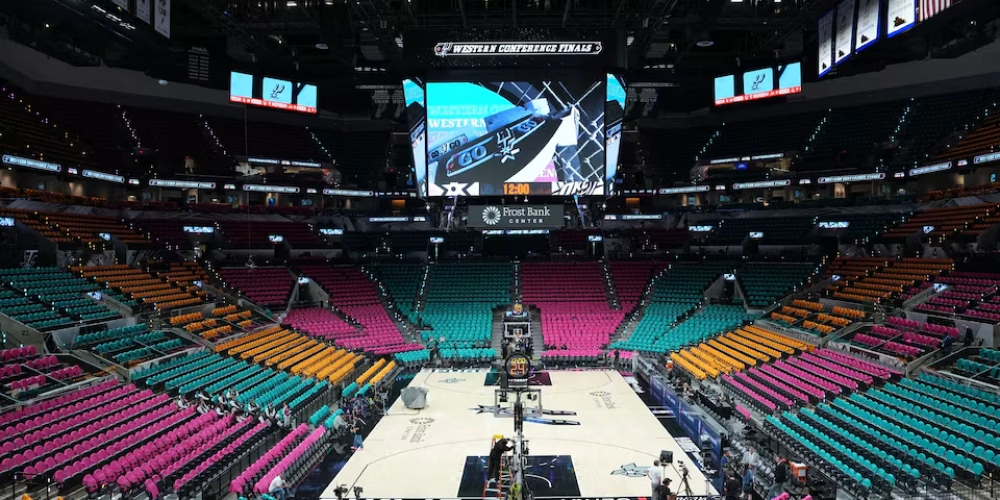
The Oklahoma City Thunder regained control of the Western Conference Finals by engineering a commanding 123-108 victory over the San Antonio Spurs at the Frost Bank Center. This crucial Game 3 triumph breaks a competitive deadlock and places the visiting team ahead 2-1 in the best-of-seven series. Relying on an extraordinary display of scoring depth, the roster managed to absorb immense pressure on the road and pull away during a highly physical second half.
What You Need to Know
The postseason clash between these two talented Western Conference rosters entered Game 3 with the series entirely even. San Antonio struck first by stealing the opening match on the road, but Oklahoma City responded quickly in the second contest to protect their home hardwood before the venue shifted to Texas. The split in the opening fixtures amplified the importance of this third meeting, as historical data shows that the winner of Game 3 in a tied playoff series goes on to win the matchup nearly seventy-five percent of the time.
San Antonio relied heavily on their length and home-court advantage to dictate the pace early in the evening. With their defensive anchor executing high-level rim protection, the home team attempted to limit the driving lanes that Oklahoma City normally exploits to generate high-percentage looks. The tactical battle required the visitors to find alternative sources of offense beyond their usual isolation scoring plays.
The adjusting strategies implemented by the visiting coaching staff during the middle periods proved to be the decisive turning point. Realizing that the starting unit faced extreme defensive pressure, the team shifted its offensive philosophy to emphasize rapid ball movement and perimeter volume. This adjustments allowed the second unit to stretch the floor and expose gaps in the home team’s secondary rotations.
Second-Unit Excellence Powers Decisive Push
The match remained tightly contested through the first two quarters, with both franchises trading leads through transition buckets and strong interior play. However, Oklahoma City broke the contest open during the second half by unleashing an overwhelming wave of scoring from their reserve rotation. The bench outpaced their counterparts significantly, providing a massive offensive cushion that left the home crowd stunned.
Rookie guard Jared McCain spearheaded the secondary unit’s explosion by pouring in 24 points on aggressive perimeter shooting, constantly finding open space as the defense collapsed inward. Backup big man Jaylin Williams delivered a flawless shooting exhibition from beyond the arc, hitting five three-pointers to contribute 18 points and pull the interior defenders out of the painted area. Defensive specialist Alex Caruso added 15 points and two steals, anchoring the transition attack during a critical fourth-quarter stretch.
While the reserves provided the necessary scoring fireworks, Shai Gilgeous-Alexander guided the offense with precise playmaking execution. The premier guard finished with 26 points and 12 assists, continually drawing double-teams before kicking the ball out to open shooters along the perimeter. Frontcourt anchor Chet Holmgren fought through heavy interior contact to add 14 points, while guard Cason Wallace chipped in 11 points and three steals to solidify the defensive effort.
San Antonio received another stellar individual performance from Victor Wembanyama, who compiled 26 points, four rebounds, and two blocked shots while playing a team-high 39 minutes. Devin Vassell contributed 20 points, and De’Aaron Fox added 15 points and six assists, but the starting lineup received minimal support from their own reserve unit. The lack of secondary scoring eventually took a toll as the home team struggled to match the torrid offensive pace set by the visitors in the final quarter.
Why This Matters
The highly competitive battle unfolding in the Western Conference Finals has captured massive attention across sports markets in the United States and global English-speaking audiences. High-stakes playoff series featuring marketable young stars generate substantial economic momentum, driving retail sales for official athletic apparel and boosting viewership across major television networks. The sustained commercial interest highlights the financial power of professional basketball postseason tournaments on regional hospitality and digital media platforms.
Furthermore, the emphasis on depth and perimeter efficiency showcased by successful rosters serves as an essential case study for basketball programs at all levels of development. The ability of reserve players to step directly into high-pressure postseason environments reinforces the importance of modern development strategies in youth pipelines. Coaching staffs throughout North America closely analyze these tactical frameworks to adapt their own training methods for future athletes.
NCN Analysis
The sheer production from Oklahoma City’s bench has altered the fundamental dynamic of this entire series. By proving they can secure a double-digit road victory through balanced roster contributions, the Thunder have demonstrated the strategic flexibility required to advance to the championship round. If their reserve unit continues to provide this caliber of long-range accuracy and defensive intensity, it minimizes the immense pressure placed on their starting backcourt.
For San Antonio, the primary objective ahead of Game 4 centers on addressing their perimeter transition defense and finding reliable offensive production outside of their primary options. The coaching staff must design adjustments that prevent the opposing reserves from finding clean looks early in possessions. Audiences should watch how both teams manage their rotations in the next game, as the home team fights to avoid a perilous 3-1 deficit before traveling back across state lines.
The championship race in the Western Conference remains an absolute test of depth and strategic endurance.
Reported by the NCN Editorial Team









