

KEY POINTS
- Iran’s Football Federation is requesting formal safety assurances from FIFA for its official delegation ahead of the 2026 World Cup in North America.
- The request centers on the legal status of the Islamic Revolutionary Guard Corps (IRGC), which is designated as a terrorist organization by the United States.
- Football officials in Tehran expressed concerns that delegates with past or present ties to the IRGC could face detention or legal action upon arrival.
The Iranian Football Federation has formally approached FIFA to secure legal and security guarantees for its officials traveling to the 2026 World Cup, hosted by the United States, Canada, and Mexico. Iranian sports leadership remains concerned that members of their traveling party may be targeted by U.S. law enforcement due to domestic policies regarding the Islamic Revolutionary Guard Corps (IRGC). This diplomatic hurdle highlights the intersection of international sports and geopolitical tension as the global tournament approaches.
What You Need to Know
The 2026 World Cup marks a historic collaboration between three North American nations, but for Iran, the trip is fraught with legal complexity. Since 2019, the United States has designated the IRGC as a Foreign Terrorist Organization. This designation allows U.S. authorities to arrest or deny entry to individuals associated with the group, a category that often includes high-ranking Iranian officials and even former conscripts.
In Iran, military service is mandatory, and many citizens are assigned to the IRGC for their term of service. Furthermore, the Iranian Football Federation has historically seen overlap between its leadership and various state apparatuses. Consequently, several high-ranking members of the footballing body may have backgrounds that put them at risk of interrogation or detention the moment they step onto American soil.
The request for FIFA intervention underscores a recurring theme in international football: the clash between FIFA’s desire to keep “politics out of the game” and the reality of national security laws. While FIFA typically mandates that host countries grant entry to all qualified teams and officials, the specific legal designations held by the U.S. Department of State create a unique conflict that may require a high-level diplomatic carve-out or a specific “sporting visa” arrangement.
Iran’s Push for World Cup Security Assurances
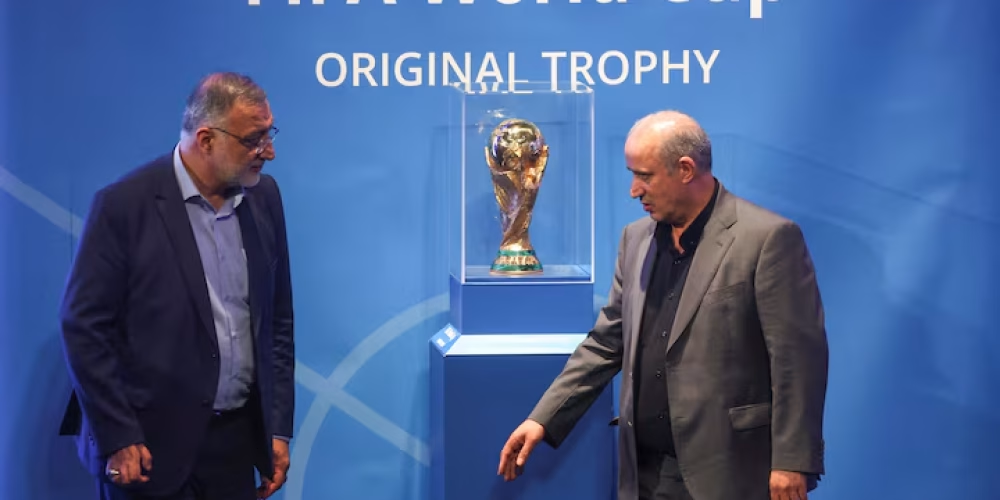
Mehdi Taj, the head of the Iranian Football Federation, recently voiced these concerns, stating that without explicit guarantees from the world governing body, the delegation’s participation could be compromised. The federation is seeking a memorandum of understanding or a formal letter of protection that would shield their staff from being apprehended by federal agents. This isn’t merely about the players, who generally travel on special sporting visas, but rather the administrative staff, coaches, and federation executives who form the backbone of the national team’s logistics.
The complexity of the situation is heightened by the fact that the 2026 tournament is spread across three countries with different legal frameworks. While Canada and Mexico have their own lists of restricted entities, the U.S. stance is notably more stringent. Iranian officials fear a scenario where a staff member is cleared for entry in Vancouver but faces legal jeopardy during a connecting flight or a knockout round match held in a U.S. city like Los Angeles or New York.
FIFA is now in a difficult position. The organization prides itself on its autonomy, yet it cannot override the federal laws of a sovereign host nation. Historically, FIFA has been able to negotiate entry for athletes from nations like North Korea or Cuba, but the specific “terrorist designation” of a state-affiliated military branch like the IRGC presents a far more difficult legal hurdle than standard diplomatic sanctions.
The Iranian side has indicated that they expect the same level of respect and protection afforded to any other competing nation. They argue that the World Cup should be a neutral ground where geopolitical designations are suspended in favor of athletic competition. However, given the current climate of international relations, the U.S. government has yet to signal any intention of waiving its domestic security protocols for the sake of the tournament.
Why This Matters
For American readers and soccer fans, this story is a reminder that the World Cup is often a barometer for global diplomacy. The presence or absence of a major regional power like Iran—and the terms under which they participate—can affect the security atmosphere of the entire tournament. If the U.S. grants a waiver for Iranian officials, it could spark significant domestic political debate regarding national security and the consistency of the “terrorist designation” policy.
Furthermore, this situation impacts the logistical success of the World Cup. If one of the 48 participating nations faces significant administrative hurdles, it could lead to boycotts or reduced participation from other allied nations, potentially tarnishing the “united” image the 2026 hosts are striving to project. For businesses and local economies in host cities, the smooth entry of all teams and their fans is critical to the financial success of the event.
NCN Analysis
This standoff is likely just the beginning of a long series of negotiations between FIFA and the U.S. State Department. It is highly probable that a compromise will be reached, perhaps involving a pre-cleared list of officials who have undergone extensive vetting by U.S. intelligence before the tournament begins. However, the Iranian demand for a “blanket guarantee” is likely a non-starter for Washington, which rarely compromises on its counter-terrorism designations for sporting events.
In the coming months, keep a close eye on the “Host City Agreements.” These documents often contain clauses regarding the freedom of movement for all FIFA-accredited personnel. If the U.S. refuses to budge, we could see Iran attempting to play all of its group-stage matches in Canada or Mexico, though the tournament bracket often makes such geographic isolation impossible. Ultimately, this will test whether the “universal” spirit of football can bridge one of the deepest divides in modern geopolitics.
The resolution of this issue will set a precedent for future global events hosted in the West where participating nations have strained diplomatic ties with the host country.
Reported by the NCN Editorial Team









