KEY POINTS
- President Lee Jae-myung calls for a transition from a standard partnership to a high-level strategic alliance with France.
- The two nations aim to lead global innovation through joint development in artificial intelligence, space technology, and nuclear power.
- Economic security and supply chain resilience serve as the primary drivers for this intensified bilateral cooperation.
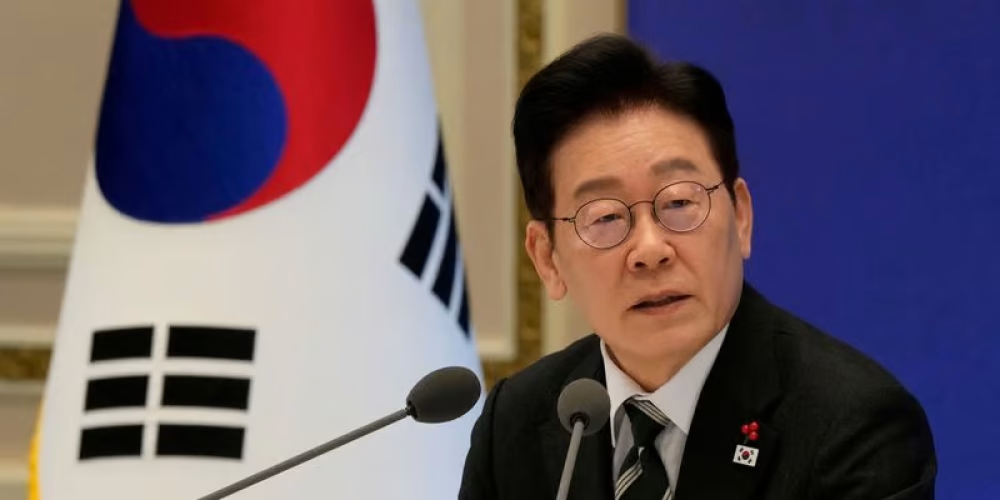
South Korean President Lee Jae-myung has signaled a major shift in diplomatic priorities, urging a deeper and more technically integrated relationship with France. Ahead of a high-profile state visit from French President Emmanuel Macron, Lee emphasized that the two nations must move beyond traditional cooperation. He proposed a new era of strategic coordination focused on the industries that will define the 21st century, specifically highlighting artificial intelligence and nuclear energy as the pillars of this future-oriented bond.
The push for this updated alliance comes at a time of significant global economic shifts. Lee noted that the world is currently navigating an era of fragile supply chains and fierce competition for technological dominance. By aligning more closely with France, South Korea seeks to build a more resilient economic foundation. This collaboration is intended to protect both nations from market volatility while ensuring they remain at the forefront of industrial innovation.
Nuclear energy stands out as a primary area for shared growth. Both South Korea and France possess advanced nuclear sectors and see carbon-free power as essential for meeting climate goals and ensuring energy independence. Lee indicated that combining their expertise could accelerate the deployment of next-generation reactors and improve the stability of global energy networks. This focus on clean energy is paired with an equally ambitious agenda for the digital realm, where AI and quantum computing are set to take center stage in upcoming bilateral discussions.
The space industry and hydrogen technology also feature prominently in the proposed strategic roadmap. As both countries look to expand their presence in the final frontier, joint research and development could lead to significant breakthroughs in satellite technology and space exploration. Furthermore, the transition to a hydrogen-based economy is viewed as a necessary step for sustainable industrial growth, providing another common ground for French and South Korean engineers and policymakers to collaborate.
This diplomatic surge coincides with the 140th anniversary of relations between the two countries. While the history of their connection is long, Lee argued that the current geopolitical climate requires a more active and robust partnership. He described the relationship as being built on shared democratic values, which provides a reliable framework for deep technical and economic integration.
Beyond the laboratory and the power plant, the South Korean leader also touched upon the importance of cultural and people-to-people exchanges. He noted that the popularity of Korean culture in France and French influence in Korea creates a strong social foundation for political and economic ties. By fostering closer connections between students, artists, and business leaders, both nations hope to ensure that their strategic alliance is supported by a genuine mutual understanding.
As President Macron arrives in Seoul, the international community is watching closely. The outcome of these summit talks is expected to set a new precedent for how medium-sized global powers can collaborate to secure their technological and economic futures. By focusing on AI, space, and nuclear energy, South Korea and France are not just looking to trade goods, but to co-create the infrastructure of tomorrow.