KEY POINTS
- A significant earthquake, reported at a magnitude between 5.8 and 6.0, struck off the eastern coast of Cuba early Tuesday morning.
- The seismic event occurred as the island nation struggled to restore its national electric grid following a total blackout on Monday.
- Seismologists and local authorities reported no immediate casualties or major structural damage in the affected provinces.
A powerful earthquake rattled eastern Cuba early Tuesday, sending residents into the streets just as the country was dealing with a massive energy crisis. The United States Geological Survey recorded the tremor at a magnitude of 5.8, while the European-Mediterranean Seismological Centre initially placed the strength at 6.0. The quake struck at 12:28 a.m. local time, with its epicenter located approximately 49 kilometers south-southwest of the municipality of Maisí at a depth of roughly 11.6 kilometers.
The timing of the earthquake was particularly challenging for the island’s population. Cuba had been plunged into darkness on Monday after a total collapse of its national electric grid. While some power had been restored to parts of the country by the time the ground began to shake, millions of people were still without electricity. Witnesses in the provinces of Santiago de Cuba and Guantánamo described a rolling motion that lasted several seconds, forcing many to evacuate their homes in the dark using flashlights and cell phones.
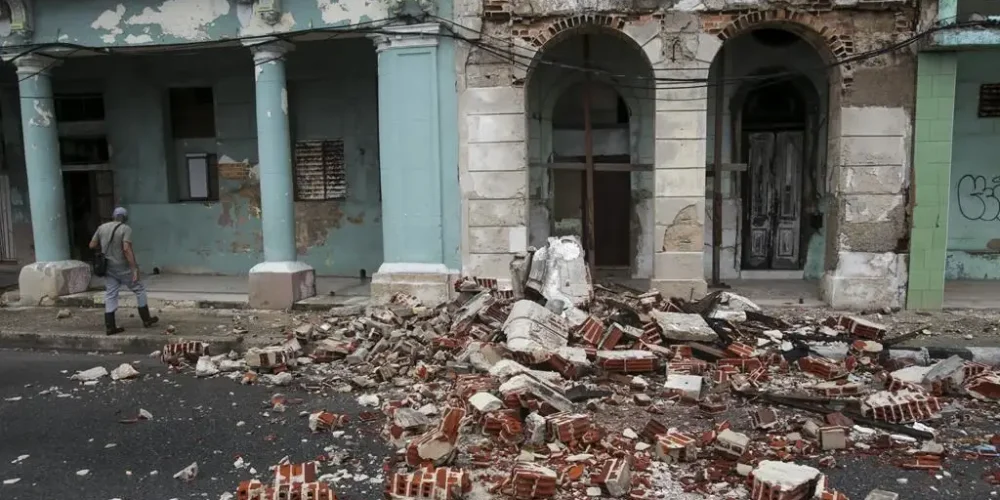
Despite the intensity of the shaking, initial assessments from Cuba’s national seismological service indicate that the impact was relatively limited. The USGS issued a green alert for the region, suggesting a low likelihood of fatalities or significant economic loss. Local civil defense teams conducted rapid checks in the towns of Imías and San Antonio del Sur, where the shaking was felt most strongly. Reports from these areas confirmed that while the tremor caused alarm, there were no immediate accounts of collapsed buildings or serious injuries.
This latest seismic activity occurred near the Septentrional-Oriente fault zone, a major boundary between the North American and Caribbean tectonic plates. This region is historically active and was the site of a massive 7.7-magnitude earthquake in 2020. Seismologists noted that Tuesday’s event was the second notable quake in the area this month, following a 5.0-magnitude tremor on March 6. The shallow nature of these recent quakes often results in more perceptible surface shaking, even at moderate magnitudes.
The earthquake adds another layer of difficulty to a country already facing severe economic and political pressure. The ongoing power crisis has been exacerbated by a shortage of fuel, which the Cuban government attributes to a tightening of international trade restrictions and blockades. These energy failures have led to sporadic protests and heightened social tension across several cities. International monitors noted that the combined stress of the blackout and the earthquake has left many residents in a state of high anxiety.
In the hours following the main event, several aftershocks were recorded, the strongest of which reached a magnitude of 4.7. Authorities have advised the public to remain vigilant and stay informed through official channels as the threat of further tremors persists. While no tsunami warning was issued, the U.S. Tsunami Warning Center monitored the situation closely to ensure there was no risk to coastal communities in the Caribbean basin.
As day broke on Tuesday, work continued to stabilize the national grid and assess any hidden structural damage to older buildings in the eastern provinces. Government officials emphasized that the priority remains the full restoration of essential services while ensuring public safety during potential aftershocks. For now, the island remains on high alert as it navigates a complex intersection of natural disaster and infrastructural collapse.