

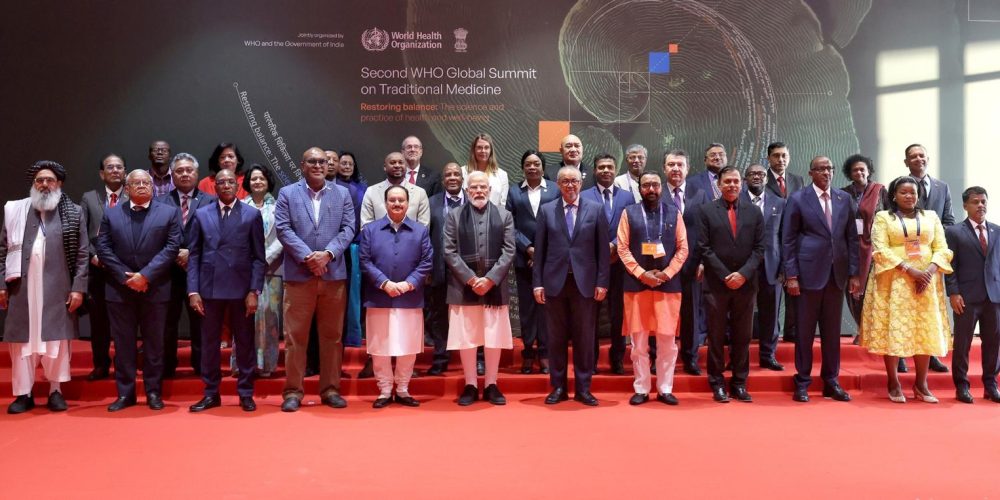
The World Health Organization has wrapped up its second Global Summit on Traditional Medicine in New Delhi, bringing a renewed global focus to age-old health practices backed by modern science and policy cooperation. The event, attended by ministers, scientists, indigenous leaders and healthcare experts from more than 100 countries, marked a key step in advancing the WHO’s Global Traditional Medicine Strategy 2025–2034, a decade-long effort to integrate proven traditional medicine into health systems worldwide.
The summit, co-hosted with the Government of India, aimed to move traditional, complementary and integrative medicine beyond dialogue and toward measurable impact. It drew over 16,000 registrations and featured more than 160 speakers discussing ways to strengthen evidence-based use of traditional approaches in mainstream care. Countries adopted the Delhi Declaration, a collective commitment to enhancing research, safety standards and regulation of traditional medicine, and to embedding these practices responsibly into health systems.
A highlight of the summit was the launch of the Traditional Medicine Global Library (TMGL), a first-of-its-kind digital platform that consolidates more than 1.6 million traditional medicine resources. The library integrates scientific publications, policy documents and digital tools—including AI-powered search and evidence gap maps—to support global research, policy-making and clinical practice. This resource is designed to make trusted knowledge on traditional and integrative medicine widely accessible to researchers, clinicians and policymakers.
Innovation was also high on the agenda, with the introduction of Health & Heritage Innovations (H2I), a programme to accelerate science-driven projects that bridge traditional health practices with new technologies such as artificial intelligence, genomics and digital health tools. Out of more than 1,000 submissions, 21 finalists were selected to join a year-long accelerator initiative that will help refine prototypes, improve regulatory alignment and connect innovators with investors.
To guide future priorities, WHO announced a new Strategic and Technical Advisory Group on Traditional, Complementary and Integrative Medicine (STAG-TM). This 19-member expert panel will advise on research needs, regulatory standards and best practices for safely integrating traditional medicine into universal health coverage. Its inaugural meeting underscored urgent needs in evidence generation, preservation of Indigenous knowledge and capacity building.
The Delhi Declaration highlighted several shared goals among participating member states, including strengthening regulation and patient safety, investing in research, and building interoperable data systems to monitor outcomes. These initiatives aim to ensure that traditional medicine complements rather than competes with conventional medical care, enhancing access, affordability and cultural relevance for diverse populations.
WHO Director-General Dr Tedros Adhanom Ghebreyesus said traditional medicine can help address persistent global health challenges, such as the rise of non-communicable diseases, inequitable access to care and the pressures of climate change. By integrating practices that respect cultural heritage and scientific evidence, he argued, health services can become more person-centred and resilient.
The summit’s outcomes reflect a shift from recognition to action. Countries are now tasked with turning political pledges into measurable health improvements by scaling access to trusted knowledge, expanding evidence-based integration of traditional practices and strengthening global partnerships. As part of broader efforts to achieve universal health coverage, WHO’s approach aims to make safe, effective traditional medicine part of comprehensive health care for communities around the world.









