

Key Points
- xAI bought a third building to expand its AI compute capacity toward nearly 2 gigawatts.
- The facility adds to the Memphis-area Colossus supercomputer campus.
- Expansion highlights xAI’s bid to challenge other major AI platforms.
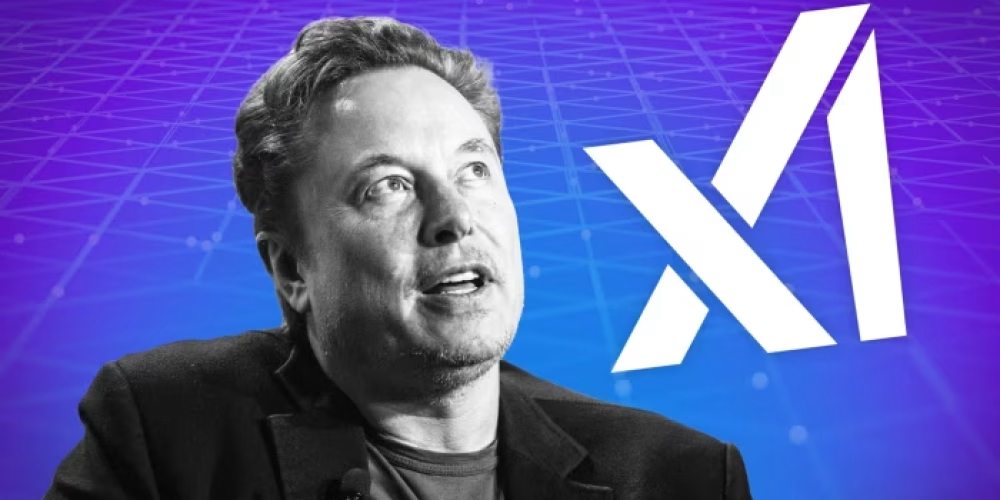
Elon Musk’s artificial intelligence venture xAI has purchased a third building to dramatically boost its computing infrastructure, underlining the company’s drive to scale its AI model training capacity. The newly acquired site is part of a broader plan to expand its supercomputer operations near Memphis, Tennessee, spotlighting xAI’s ambition to rival leading AI firms.
The new facility, known as MACROHARDRR, sits adjacent to xAI’s existing Colossus and Colossus 2 supercomputer campuses. Musk shared news of the purchase on social platform X, signaling that this acquisition will help push xAI’s total training capacity toward nearly two gigawatts of compute power.
That computing power, analysts say, would place xAI among the most advanced AI infrastructure efforts globally. The Colossus cluster, already one of the largest in existence, is designed to house massive numbers of graphics processing units (GPUs). With this new addition, xAI aims to train larger, more sophisticated AI models and accelerate progress toward its long-term goals.
Plans call for the newly purchased building to be converted into a data center in 2026. The site lies in Southaven, Mississippi, just outside Memphis, according to local reports. Developers are also constructing nearby power infrastructure, including a natural gas plant, to meet the enormous energy demands required by such large-scale compute operations.
Industry observers note that AI compute capacity has become a central battleground in the tech sector. Competitors such as OpenAI, Anthropic, and major cloud providers are all investing heavily in data centers and GPU arrays to train next-generation models. xAI’s rapid build-out underscores Musk’s intent to compete at the highest levels of AI development.
Critics of the expansion point to significant environmental and energy concerns. Running and cooling large AI data centers consumes huge amounts of electricity, and the proximity of the new site to a natural gas power plant has drawn scrutiny from climate activists. Some experts argue that the industry must balance compute growth with sustainability considerations.
xAI’s broader strategy includes raising funds and securing hardware to fuel its growth. Executives have discussed ambitious plans involving hundreds of thousands—or even millions—of GPUs to support future AI training tasks. These plans reflect the escalating arms race in the AI world, where compute power often translates directly into research and competitive advantage.
Musk’s decision to name the new building “MACROHARDRR” appears to be a tongue-in-cheek nod to major tech rivals, while also emphasizing xAI’s intention to build its own branded technology stack. Observers say this reflects not just infrastructure growth, but a branding effort to position xAI as a challenger to entrenched players in the AI market.
While xAI has not publicly commented beyond Musk’s social post, industry analysts see the expansion as a clear message: infrastructure matters. As AI models grow in size and capability, the demand for massive compute power will only intensify, driving further competition among tech giants and newcomers alike.
Through this third purchase, xAI signals its commitment to build a computing engine capable of fueling future breakthroughs in generative AI. The expansion emphasizes how essential scale has become in developing cutting-edge AI technologies.









