

KEY POINTS
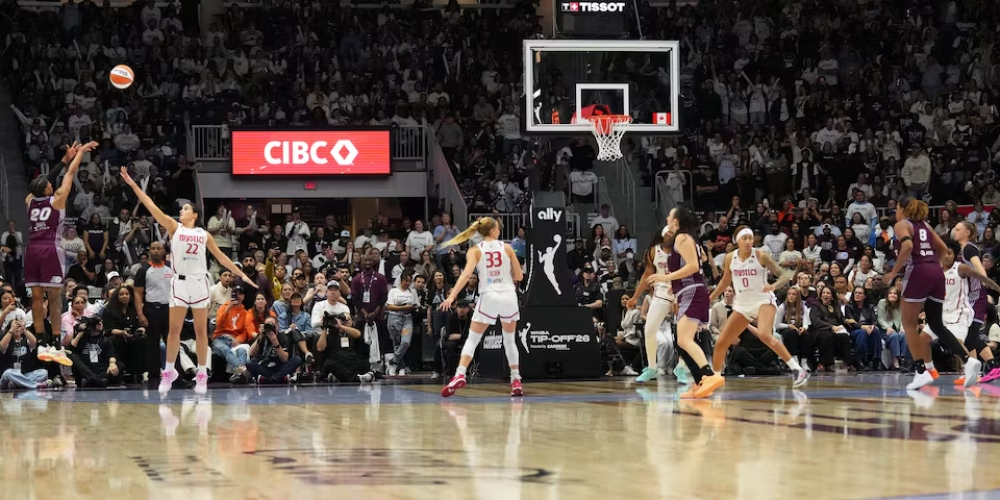
- The Toronto Tempo played their historic first regular-season game on May 8, 2026, hosting the Washington Mystics at Coca-Cola Coliseum.
- In a closely contested inaugural matchup, the Tempo fell 68-65 despite a stellar 27-point performance from veteran guard Marina Mabrey.
- The franchise is one of two expansion teams joining the WNBA for its 30th season, alongside the Portland Fire, marking the league’s first expansion outside the United States.
Professional women’s basketball reached a milestone on Friday night as the Toronto Tempo officially tipped off their inaugural season, bringing WNBA action to Canada for the first time. Playing before a packed crowd at the Coca-Cola Coliseum, the Tempo showcased a competitive spirit that pushed the veteran Washington Mystics to the final whistle. While the scoreboard read 68-65 in favor of the visitors, the evening was widely celebrated as a transformative moment for the sport’s northern footprint.
What You Need to Know
The launch of the Toronto Tempo is the culmination of a multi-year expansion effort by the WNBA to capitalize on the surging global popularity of women’s basketball. Owned by Kilmer Sports Ventures, the franchise was awarded to Toronto in May 2024, becoming the league’s 14th team. The expansion era reflects a broader trend of increased investment and viewership in women’s sports, with Toronto serving as a critical gateway for the league’s international ambitions.
Strategically, the Tempo roster was built through a combination of a dedicated expansion draft in April 2026 and traditional free-agent signings. The front office prioritized a “global-first” approach, selecting players from diverse international backgrounds to reflect Toronto’s multicultural identity. This roster construction included acquiring key veterans like Marina Mabrey and Kia Nurse, alongside high-potential draft picks such as UCLA’s Kiki Rice.
The inaugural season consists of 44 games, a schedule designed to test the endurance of the newly formed squad. While the majority of home games will be held at the 8,500-seat Coca-Cola Coliseum, the league has also scheduled special “heritage” games in Montreal and Vancouver later this summer. These satellite games are intended to gauge the viability of future expansion sites across Canada and solidify the Tempo’s status as “Canada’s Team.”
A Night of Firsts at Coca-Cola Coliseum
The energy inside the arena was palpable long before the opening tip-off. Head coach Sandy Brondello, a veteran leader with championship experience, emphasized the importance of defensive discipline and chemistry in the days leading up to the debut. The Tempo responded by holding the Mystics to just 68 points, a defensive feat that kept the expansion side within striking distance throughout the four quarters.
Marina Mabrey, the cornerstone of the Tempo’s backcourt, was the undisputed star of the evening. She finished with 27 points and seven rebounds, nearly willing the team to a comeback victory in the closing minutes. Her ability to score from the perimeter and drive through traffic provided a blueprint for the Tempo’s offensive identity. However, shooting struggles from the rest of the squad and a few critical turnovers—a common byproduct of a new roster still finding its rhythm—ultimately allowed Washington to escape with the win.
Local hero Kia Nurse, who hails from nearby Hamilton, Ontario, provided the emotional heartbeat for the team. While her scoring was modest in the opener, her presence on the floor drew massive ovations from the home crowd. The defensive efforts of Nyara Sabally and Temi Fagbenle were also noteworthy, as they battled in the paint against a physically imposing Washington frontcourt. Despite the loss, the Tempo won the battle on the glass, a promising sign for their competitiveness in the weeks to come.
The game concluded with a standing ovation from the Toronto faithful, acknowledging the high quality of play and the significance of the occasion. For a team that had only been together for a matter of weeks, the level of synchronization displayed against an established playoff contender like the Mystics suggests that the Tempo will be more than just a “participation” story in 2026.
Why This Matters
For American fans and global readers, the success of the Toronto Tempo is a litmus test for the WNBA’s viability as a truly international league. The high attendance and media interest surrounding the Toronto debut suggest that there is a significant, untapped market for professional women’s basketball outside of the U.S. This could lead to further expansion into European or South American markets, fundamentally changing the economic landscape of the sport.
Additionally, the Tempo’s arrival provides a new platform for Canadian athletes to play at the highest level in front of a home audience. This visibility is expected to inspire a new generation of female basketball players in North America, potentially increasing the talent pipeline for both the WNBA and international competitions like the Olympics. For businesses and broadcasters, the Tempo represents a fresh commercial frontier, offering unique branding opportunities in one of North America’s most diverse and sports-crazed cities.
NCN Analysis
The Toronto Tempo’s first outing was a tactical victory masked by a narrow scoreboard loss. Marina Mabrey proved she could carry a heavy offensive load, but the team’s long-term success will depend on developing a secondary scoring option. Kiki Rice and Teonni Key showed flashes of their draft pedigree, but like most rookies, they will need time to adjust to the speed and physicality of the WNBA.
Watch for the Tempo to refine their late-game execution as the season progresses. Coach Brondello is known for making sharp mid-season adjustments, and as the chemistry between the “Villanova-style” guard play and the international frontcourt deepens, Toronto could easily contend for a playoff spot in their first year. The upcoming schedule includes a difficult road trip, which will be the ultimate test of the team’s mental toughness.
Canada has officially arrived on the WNBA stage, and if the first game is any indication, the Toronto Tempo are here to compete, not just to exist.
Reported by the NCN Editorial Team









