

KEY POINTS
- Manchester City manager Pep Guardiola formally conceded that the Premier League title is no longer in his team’s hands following a pivotal shift in the standings.
- The reigning champions now require significant stumbles from their primary rivals to secure what would be a historic fifth consecutive domestic trophy.
- Internal frustrations regarding defensive lapses and missed clinical opportunities have surfaced as the club enters the final weeks of the 2025/26 campaign.
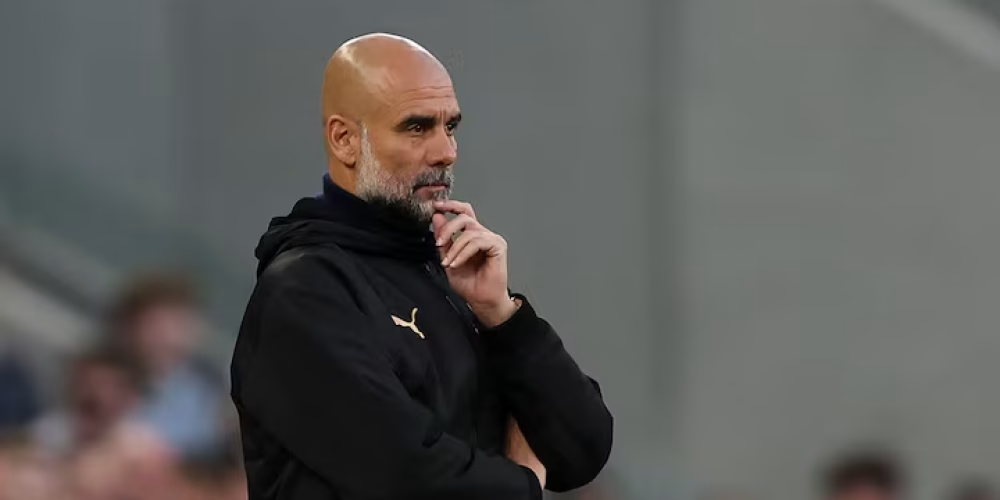
Manchester City’s grip on the English top flight appears to have finally loosened, with manager Pep Guardiola acknowledging that the club no longer dictates its own destiny in the hunt for the Premier League trophy. After years of late-season dominance, the sky-blue side of Manchester now finds itself in the unfamiliar position of needing outside help to climb back to the top of the table. This admission marks a psychological turning point in a season that has tested the depth and resilience of one of the most successful squads in modern sports history.
What You Need to Know
To understand the weight of Guardiola’s admission, one must look at the unprecedented era of success Manchester City has enjoyed over the last decade. Since the Spaniard’s arrival in 2016, the club has transformed from a domestic powerhouse into a global juggernaut, winning six Premier League titles, including the last four in a row. Their ability to produce “perfect” runs—winning 10 or 15 games in a row during the spring—has often demoralized challengers like Arsenal and Liverpool, making City’s eventual victory feel like a mathematical inevitability.
However, the 2025/26 season has lacked that trademark clinical consistency. Injuries to key personnel in the midfield and a rare vulnerability on the counter-attack have seen City drop points in matches where they previously would have cruised to victory. In the Premier League, where the margin for error is razor-thin, these minor fractures have allowed hungry competitors to build a lead that transcends City’s usual late-season surge.
The historical context is equally important. No team in the history of English football has ever won five consecutive top-flight titles. The pressure of chasing this “immortality” has clearly weighed on the squad, leading to a campaign defined more by grit and struggle than the fluid, tactical masterclasses fans have come to expect. Guardiola’s public concession is not just a tactical observation; it is a signal to his players and the fans that the era of absolute control has met its greatest challenge yet.
The Shift in the Premier League Power Balance
The current predicament for Manchester City stems from a series of high-stakes results that have favored their direct rivals. In the Premier League, “control” is defined by a team’s ability to win their remaining games and guaranteed the trophy regardless of what others do. By admitting this control is gone, Guardiola is highlighting the fact that even if City wins every remaining fixture, they could still finish second or third. This psychological shift removes the “fear factor” that usually hampers opponents when facing the City machine in May.
Tactically, the team has struggled to replace the defensive transitions that were once their greatest strength. Opponents have found success by sitting deep and exploiting the space behind City’s high defensive line, a trend that was once considered a suicide mission but has now become a viable blueprint for mid-table clubs. This tactical evolution across the league has forced City into more “basketball-style” end-to-end games, which do not suit Guardiola’s preference for total positional suppression.
Furthermore, the fatigue of competing at the highest level for nearly a decade seems to be catching up with the core veteran group. While stars like Erling Haaland continue to find the net, the supporting cast has found it difficult to maintain the suffocating pressure required to kill off games early. This has led to several late-game collapses and draws that have ultimately handed the advantage to teams like Arsenal, who have looked increasingly composed as the season nears its climax.
The timeline of this admission is also critical. Coming into the final stretch of May, usually the month where City is at its most lethal, the manager’s words serve as a reality check. By shifting the pressure onto the league leaders, Guardiola may be attempting a final psychological gambit, hoping that the burden of being “expected” to win will cause his rivals to stumble. Nevertheless, the cold reality of the points total suggests that the crown is currently residing elsewhere.
Why This Matters
For American fans and global sports consumers, the potential fall of the Manchester City dynasty represents a massive shift in the entertainment landscape of international soccer. The Premier League is the most-watched sports league in the world, with a massive and growing viewership in the United States. A change in leadership at the top of the table breathes new life into the “product,” proving that even the most well-funded and strategically perfect organizations are susceptible to the cycles of sports exhaustion and competition.
Beyond the pitch, this story resonates with the American business and sports community because it mirrors the challenges of maintaining “corporate” dominance. Investors and stakeholders in global sports franchises—many of whom are American-based private equity firms—watch Manchester City as the gold standard of operational efficiency. Their potential failure to secure a fifth title serves as a case study in the difficulty of sustained excellence and the importance of continuous innovation, even when you are at the top. It also highlights the unpredictability that makes the Premier League a premier destination for U.S. broadcasting giants like NBC.
NCN Analysis
At NextClickNews, we view Guardiola’s comments as more than just a concession; they are a calculated piece of man-management. By publicly stating that City is no longer in control, he is effectively telling his players to stop looking at the standings and start focusing on individual performances. It is a “nothing to lose” mentality that could ironically make City more dangerous in these final weeks. If the pressure of the “five-in-a-row” record is lifted, we might see a return to the free-flowing football that has been missing for much of the spring.
However, the long-term outlook suggests that the Premier League is entering a new era of parity. The gap between the “Big Six” and the rest of the league has been closing due to smarter scouting and the influx of diverse tactical minds. Whether or not City manages to snatch the title in a dramatic final day, the blueprint to beat them has been published. Moving forward, expect Manchester City to undergo a significant squad refresh this summer, as they look to reclaim the “control” that Guardiola so candidly admits has slipped away.
The era of City’s undisputed dominance may not be over, but its aura of invincibility has certainly been shattered.
Reported by the NCN Editorial Team









