

KEY POINTS
- A relentless week of severe weather is battering at least a dozen states, with the central U.S. facing repeated rounds of destructive hail, high winds, and tornadoes.
- Multiple confirmed tornadoes have already touched down in Kansas, Iowa, Minnesota, and Wisconsin, causing significant structural damage and power outages.
- Meteorologists warn that the volatile atmospheric setup, fueled by unseasonable warmth and jet stream energy, will keep millions of residents under high-alert through Friday.
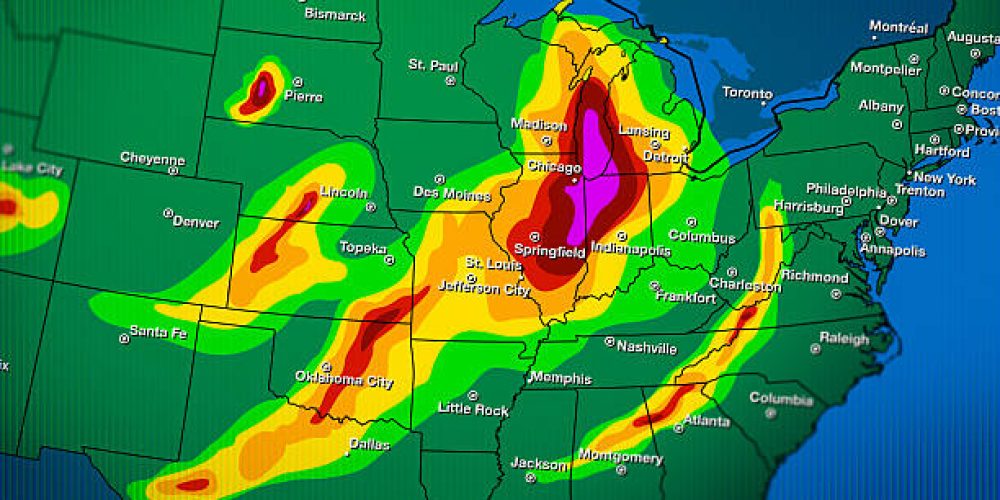
A powerful and prolonged weather system is currently carving a path of destruction across the American heartland, putting tens of millions of people at risk. From the plains of Texas to the Great Lakes, the central United States is enduring a multi-day onslaught of supercell thunderstorms capable of producing softball-sized hail and dangerous tornadoes. As the storm front migrates eastward, residents in major metropolitan hubs are being urged to finalize their emergency plans and prepare for potential evacuations in flood-prone areas.
What You Need to Know
This week’s atmospheric volatility is the result of a classic but intensified collision between two massive air masses. Warm, humid air surging northward from the Gulf of Mexico is clashing with energetic pulses from the jet stream, creating an environment primed for “convective” weather. While spring is traditionally the peak of the severe weather season in the U.S., the scale and duration of this specific system—lasting a full five days—is notably intense, testing the resilience of local emergency management across the Midwest.
Sarcopenia is often discussed in medical circles, but in the context of infrastructure, “structural sarcopenia” or the weakening of the nation’s flood defenses is also a concern during such events. In northern Michigan and Wisconsin, the threat is twofold: the immediate danger of tornadoes is coupled with the risk of catastrophic flooding. Saturated soils from recent snowmelt mean that any additional heavy rainfall cannot be absorbed, leading to rapid rises in river levels that threaten aging dams and local roadways.
Understanding the mechanics of these storms requires a look at “wind shear”—the change in wind speed and direction with height. When strong shear overlaps with high instability (CAPE), thunderstorms can begin to rotate, forming supercells. These are the most dangerous types of storms, as they are the primary producers of significant tornadoes and the “giant” hail that has already been reported in the Minneapolis suburbs this week.
The Relentless March of Supercell Thunderstorms
The outbreak began in earnest on Monday evening as a southward-moving cold front stalled over the Upper Midwest. This boundary acted as a trigger for a series of explosive storm developments. In southern Minnesota alone, at least three tornadoes were confirmed, with preliminary ratings ranging from EF-0 to EF-1. One of these twisters near Truman, Minnesota, reportedly leveled farm buildings and tossed heavy trailers across fields, demonstrating the raw power of even “minor” ratings.
The focus shifted on Tuesday toward more populated corridors, including Chicago, Milwaukee, and Des Moines. These cities, along with their surrounding suburbs, were placed under a Level 3 out of 5 risk for severe weather—a category that covers more than 14 million people. Forecasters highlighted the threat of “lime-sized” hail and the potential for strong tornadoes (EF-2 or higher) as storms gained energy from unseasonable afternoon heating. The sheer geographic breadth of the threat zone, spanning from West Texas into the Great Lakes, has forced the National Weather Service to issue hundreds of warnings in a matter of hours.
As we move toward the latter half of the week, the primary concern is shifting from individual tornadoes to “mesoscale convective systems”—large clusters of storms that can produce widespread damaging winds known as straight-line winds. These winds can often be as destructive as a small tornado, capable of uprooting mature trees and snapping power poles. On Wednesday and Thursday, the focus will remain on the Ohio Valley and parts of the Northeast, though a final surge of energy is expected to re-ignite the Plains by Friday before a cooler, more stable air mass finally arrives over the weekend.
Local authorities in Michigan have already issued evacuation “go-bag” alerts for residents living downstream of major dams, such as the Cheboygan County Lock and Dam. The unpredictability of water levels, combined with the forecasted heavy downpours, has created a race against time for public works departments. In cities like Ottawa, Kansas, where power was knocked out to most of the town following a Monday tornado, recovery efforts are being hampered by the arrival of subsequent storm rounds.
Why This Matters for Americans
For the average American household, this week of severe weather serves as a high-stakes stress test for personal and community preparedness. Beyond the immediate threat to life, these storms carry a massive economic price tag. Large-scale hail events are among the costliest natural disasters for the insurance industry, often resulting in billions of dollars in claims for damaged roofs and vehicles. As these “billion-dollar disasters” become more frequent, homeowners across the central U.S. may face rising premiums and stricter coverage requirements.
Furthermore, the disruption to the national supply chain is significant. The “Path of Totality” for these storms covers some of the nation’s most critical agricultural and transit corridors. When tornadoes or floods close major interstates like I-80 or I-35, the ripple effects are felt in the price of goods and the speed of logistics from coast to coast. For those in Ireland and Sweden, this serves as a reminder of the increasing volatility of global weather patterns that can impact international energy markets and food security.
NCN Analysis
The frequency and intensity of these “week-long” storm threats are beginning to redefine what we consider a standard spring season. While a single storm is weather, a pattern of these multi-day outbreaks is increasingly linked to a warming Gulf of Mexico, which provides more “fuel” (moisture and heat) to the atmosphere. We expect that in the coming years, we will see a shift in “Tornado Alley” eastward, as the dry line—the boundary where dry air meets moist air—continues to migrate toward more densely populated areas in the Mid-South and Ohio Valley.
Readers should watch the development of Friday’s final storm round carefully. If the jet stream energy remains as potent as current models suggest, we could see a “grand finale” outbreak in the southern Plains that rivals the start of the week. The takeaway is clear: the era of the “isolated” spring storm is giving way to extended periods of high-intensity risk, requiring a permanent shift in how we build our homes and plan our lives in the heart of the country.
Preparedness and rapid response are the only effective shields against an increasingly aggressive atmospheric engine.
Reported by the NCN Editorial Team









