

KEY POINTS
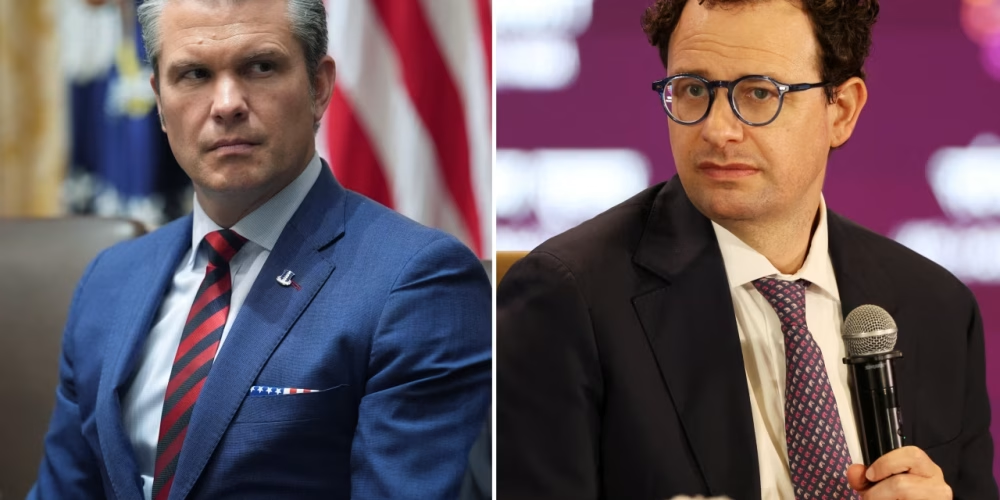
- Treasury Secretary Scott Bessent and Fed Chair Jerome Powell have reportedly issued private warnings to bank executives regarding AI integration.
- The focus of the concern centers on the rapid adoption of Anthropic’s generative models within the core infrastructure of major financial institutions.
- Regulators are specifically worried that a lack of oversight in AI-driven decision-making could trigger systemic instability or unforeseen market crashes.
Top U.S. financial regulators have taken the unusual step of directly warning the nation’s biggest bank CEOs about the potential dangers of integrating advanced artificial intelligence into their operations. Treasury Secretary Scott Bessent and Federal Reserve Chair Jerome Powell are reportedly signaling that the rush to deploy Anthropic’s latest models could create vulnerabilities that the current financial system is not prepared to handle. This high-level intervention suggests that Washington is moving from general curiosity about AI to an active stance on risk mitigation within the banking sector.
What You Need to Know
The financial world is currently in the midst of a gold rush for generative artificial intelligence. Major banks have been aggressively partnering with AI firms to automate everything from customer service and coding to complex risk assessment and high-frequency trading. Anthropic, a leading AI safety and research company, has become a preferred partner for many institutions due to its “Constitutional AI” approach, which is designed to make models more predictable and aligned with human values.
Despite these safety claims, the sheer scale of the implementation is causing jitters at the highest levels of government. The Federal Reserve and the Treasury Department serve as the ultimate guardians of the American economy, and their primary goal is to prevent a repeat of the systemic collapses seen in 2008. The concern is that if multiple banks rely on the same underlying AI model for risk management, a single “hallucination” or technical glitch in that model could lead to a coordinated, catastrophic failure across the entire market.
Washington’s scrutiny reflects a broader global debate over how to regulate a technology that is evolving faster than the law. In the United States, there is no single “AI Law,” meaning regulators must rely on existing financial statutes to police how these tools are used. By pulling bank CEOs aside, Bessent and Powell are emphasizing that the responsibility for any AI-driven disaster will fall squarely on the shoulders of the human executives, regardless of how advanced the software may be.
Addressing Anthropic Model Risks in Banking
The specific dialogue between regulators and Wall Street leaders has centered on the “black box” nature of advanced neural networks. When a bank uses an Anthropic model to determine creditworthiness or to manage liquidity, it can be difficult for human auditors to explain exactly why the machine made a specific decision. This lack of transparency, often referred to as “explainability,” is a major hurdle for compliance officers who must prove that their institutions are not engaging in discriminatory practices or taking on excessive, hidden risks.
The reported warnings from Scott Bessent and Jerome Powell highlight a fear of “model monoculture.” In this scenario, if the majority of the financial sector adopts Anthropic’s technology, the diversity of decision-making that usually keeps markets stable disappears. Instead of thousands of human traders making different bets, you have a few powerful algorithms moving in lockstep. If those algorithms perceive a market signal incorrectly at the same time, the result could be a flash crash that evaporates billions of dollars in seconds.
Banking executives have countered these concerns by pointing to the massive efficiency gains and improved fraud detection that AI provides. However, the Federal Reserve appears more interested in the “tail risks”—the low-probability, high-impact events that could bankrupt a firm. The discussion reportedly touched on the need for rigorous stress-testing of AI models, similar to the annual checks banks undergo to ensure they can survive a recession. Regulators are essentially asking for a “kill switch” or a robust human-in-the-loop system that can override AI decisions during periods of extreme volatility.
Furthermore, the involvement of Anthropic is notable because the company has positioned itself as the “safer” alternative to rivals like OpenAI. By targeting Anthropic specifically in these conversations, regulators are sending a message that even the most safety-conscious AI developers are not above scrutiny. The goal is to ensure that the pursuit of innovation does not outpace the development of guardrails. This tension between the speed of Silicon Valley and the caution of Washington is likely to define the next decade of American financial policy.
Why This Matters
For the average American consumer, this high-level friction between regulators and banks is a sign that their personal finances are increasingly being managed by algorithms. If these warnings are ignored and a systemic failure occurs, it could impact everything from the availability of mortgages to the stability of retirement funds. When the Treasury Secretary and the Fed Chair speak in unison about a specific technology, it usually precedes a shift in policy that could lead to stricter lending standards or higher costs for banking services as firms invest more in compliance and human oversight.
For global readers in Ireland, Sweden, and beyond, this sets a significant international precedent. The U.S. financial system often serves as the “anchor” for global markets, and American regulatory trends frequently influence the European Central Bank and other international bodies. If the U.S. begins to impose strict limitations on how banks use models like those from Anthropic, it could lead to a fragmented global AI landscape where European and American banks operate under vastly different technical and legal constraints. This could affect international trade, cross-border investments, and the global competitiveness of Western financial institutions.
NCN Analysis
The private warnings issued by Scott Bessent and Jerome Powell mark a transition from theoretical concern to operational interference. It is clear that the government is worried that the current “AI boom” has more in common with the “subprime mortgage” era than Wall Street would like to admit. The move to target Anthropic is a tactical one; it signals that regulators are looking at the specific pipes and wires of the financial system, not just the broad concept of automation. We expect that this is the first step toward a formal regulatory framework that will require banks to disclose their AI “lineage” and maintain significant capital reserves against potential algorithmic failures.
Looking forward, the financial sector should prepare for a period of “AI Cooling.” While the technology will continue to advance, the pace of its deployment in mission-critical banking functions will likely slow down as CEOs weigh the benefits against the threat of regulatory retaliation. Investors should keep a close eye on the upcoming quarterly reports from major banks to see how much they are spending on AI safety versus AI development. The real test will come during the next period of market turbulence; if the algorithms hold steady, the regulators may back off. If they don’t, we are looking at a fundamental restructuring of how technology is governed in the United States.
The era of unchecked AI experimentation on Wall Street is ending as Washington prepares to bring the “black box” into the light.
Reported by the NCN Editorial Team.









