

KEY POINTS
- President Trump confirmed that US forces will not leave the Persian Gulf until Iran fully complies with the ceasefire.
- The military footprint is serving as a verification mechanism to ensure the Strait of Hormuz remains open to commercial trade.
- Tehran has criticized the continued presence as an obstacle to peace, while the US maintains it is a necessary deterrent.
President Donald Trump declared on Thursday that the United States military will maintain a robust presence in the Middle East until Tehran demonstrates absolute compliance with the terms of the recently brokered ceasefire. Speaking from the White House, the President emphasized that while the temporary truce has opened the Strait of Hormuz, the withdrawal of American naval and air assets is strictly contingent on Iranian behavior. This firm stance signals that the administration intends to use military leverage as a permanent “insurance policy” during the delicate two-week negotiation window.
What You Need to Know
The current standoff follows a breakthrough two-week ceasefire aimed at ending a series of violent maritime confrontations in the Persian Gulf. For much of early 2026, global energy markets were held hostage by “gray zone” warfare, characterized by drone strikes on tankers and clandestine mining operations. The closure of the Strait of Hormuz, a conduit for roughly 20% of the world’s petroleum liquids, sent shockwaves through the global economy, forcing a direct intervention from the Trump administration to prevent a total logistical collapse.
The newly minted agreement was designed to act as a pressure-release valve, allowing commercial traffic to resume while diplomats worked on a more sustainable security framework. However, the inherent lack of trust between Washington and Tehran has made the implementation of the deal a fraught process. The White House has made it clear that it views the Iranian Revolutionary Guard Corps (IRGC) with extreme skepticism, fearing that the pause in hostilities may be used by the regime to reorganize its unconventional forces rather than seek a genuine peace.
Historically, US military doctrine in the region has oscillated between “maximum pressure” and strategic pivots toward the Indo-Pacific. Under the current administration, the pendulum has swung back toward a heavy footprint in the Gulf. By keeping two carrier strike groups and an expeditionary unit within striking distance of the Iranian coast, the US is attempting to create a “monitored peace” where any violation by Tehran is met with an immediate and disproportionate kinetic response.
Maintaining the US Military Presence in the Gulf
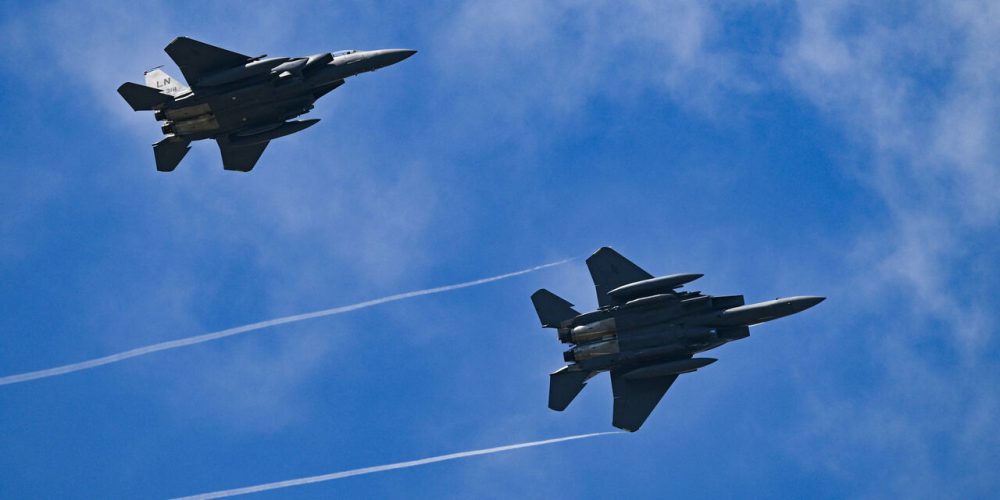
The President’s latest comments clarify the operational parameters of the American mission during this ceasefire. While some regional analysts expected a symbolic drawdown to encourage Iranian cooperation, the administration has opted for the opposite. The US military presence currently includes high-altitude surveillance drones, Aegis-equipped destroyers, and rapid-response special operations teams stationed across bases in Qatar and Bahrain. This deployment is specifically tasked with monitoring the “safe passage” lanes in the Strait to ensure that no covert interference occurs under the cover of the truce.
The strategic logic behind this persistence is to deny Tehran any “room to breathe.” Senior officials within the Pentagon have indicated that the surveillance net currently draped over the Persian Gulf is the most sophisticated in history. By maintaining this posture, the US aims to verify Iranian compliance in real-time. This involves tracking the movement of IRGC fast-attack boats and ensuring that land-based anti-ship missile batteries remain in a non-threatening state. The President noted that the goal is not a permanent occupation, but a guaranteed end to the “extortion” of global trade.
Diplomatic sources suggest that the Iranian leadership is sensitive to this continued military shadow. Tehran has argued that the heavy US presence is a violation of the “spirit” of the de-escalation deal, which they claim should lead to a neutralized maritime environment. However, the White House has rejected this narrative, asserting that American forces are the only credible guarantors of freedom of navigation in a region where international norms have repeatedly been flouted.
The timeline for any potential US departure remains entirely open-ended. The administration has refused to provide a specific date for a drawdown, stating only that the military will remain “for as long as it takes” to see the deal through to its final, permanent phase. This creates a high-stakes environment for the upcoming technical talks in Muscat, where Iranian negotiators will likely attempt to trade security concessions for a reduction in the American naval footprint.
Why This Matters
For Americans, the continued deployment of US forces is a double-edged sword that directly impacts domestic stability. On one hand, the military’s role in securing the Strait of Hormuz is the primary reason gas prices have begun to retreat from their March highs. Without the US Navy acting as a “global sheriff” for oil tankers, the cost of transportation and manufacturing in the US would remain prohibitively high, potentially triggering a domestic recession. For the average voter, the military’s success in the Gulf is measured by the digital signs at their local gas station.
On the other hand, a prolonged and aggressive military posture carries the inherent risk of an accidental escalation. With US and Iranian assets operating in such close proximity, the margin for error is razor-thin. A single misunderstanding or a rogue commander on either side could ignite a conflict that the ceasefire was specifically designed to avoid. For American families with relatives serving in the region, the President’s pledge of a continued presence means that the period of highest tension is far from over, despite the diplomatic headlines.
NCN Analysis
The President’s decision to keep the US military presence in place is a calculated gamble on “deterrence through proximity.” At NextClickNews, we view this as a clear indication that the administration does not believe a signature on a document is sufficient to change decades of Iranian strategic goals. By refusing to withdraw, Trump is effectively telling Tehran that the ceasefire is not a victory, but a probation period. The risk is that this “heavy-handed” approach could provide Iranian hardliners with the domestic political capital they need to scuttle the deal entirely, claiming that the US is acting as an imperial aggressor rather than a peacekeeper.
Looking forward, the critical metric to watch will be the “rules of engagement” issued to US commanders on the ground. If the US Navy begins actively boarding vessels to check for Iranian weaponry or expanding its patrol zones, it could be seen as an escalation. However, if the presence remains purely observational and defensive, it may provide the necessary backbone for a long-term maritime treaty. The next ten days will determine if this military pressure leads to a diplomatic breakthrough or a return to the “Tanker War.”
The United States has made it clear that in the game of Middle Eastern diplomacy, the pen is only as strong as the carrier group backing it up.
Reported by the NCN Editorial Team









