

KEY POINTS
- Jensen Huang is expected to reveal the successor to the highly successful Blackwell chip architecture during his keynote at the annual GTC event.
- The conference will focus on “physical AI” and the integration of generative intelligence into robotics and industrial automation.
- Industry analysts anticipate major updates to Nvidia’s software ecosystem, specifically the CUDA platform, to maintain its dominant market share.
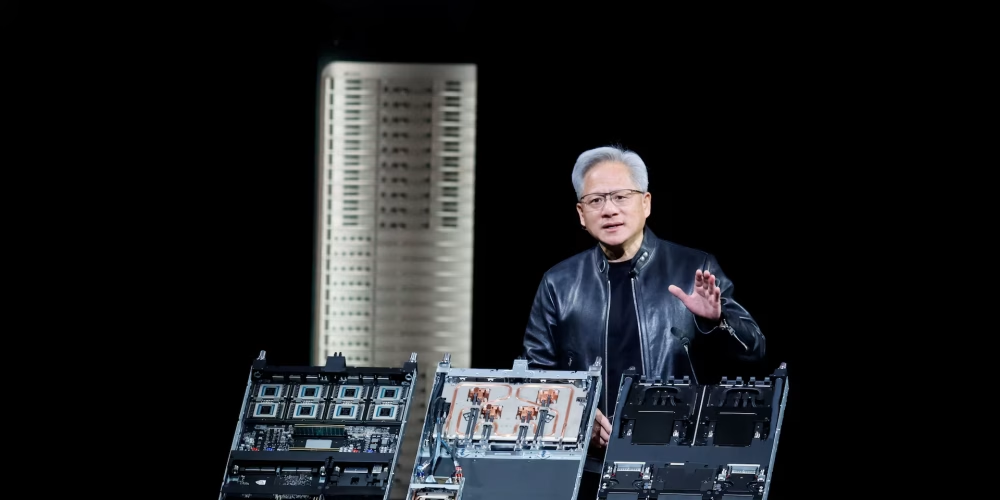
The global technology industry has turned its attention to the opening of Nvidia’s flagship GTC conference, where CEO Jensen Huang is poised to announce a new era of artificial intelligence hardware and software. Often referred to as the “AI Woodstock,” the event serves as the primary stage for Nvidia to showcase the technological roadmap that currently powers the majority of the world’s data centers. This year’s keynote is expected to be particularly significant as the company moves to solidify its lead against a growing field of competitors.
At the heart of the anticipated announcements is the debut of a new GPU architecture designed to surpass the capabilities of the current Blackwell series. While Blackwell set new benchmarks for large language model training, the next iteration is rumored to focus on unprecedented energy efficiency and specialized processing for “inference”—the stage where AI models actually respond to user queries. As global energy grids face increasing pressure from massive data center expansions, Nvidia’s ability to deliver more compute power per watt has become a critical selling point for cloud providers like Microsoft, Google, and Amazon.
Beyond raw silicon, the conference is expected to highlight a strategic shift toward “physical AI.” This concept involves the application of generative AI models to the physical world, specifically in the realms of humanoid robotics and autonomous manufacturing. Nvidia has been heavily investing in its Omniverse platform, a digital twin simulation environment that allows developers to train robots in a virtual space before deploying them in reality. By providing the “brains” for these machines, Nvidia aims to expand its reach from digital servers into the trillion-dollar global industrial sector.
The software layer of Nvidia’s business, particularly the CUDA programming model, will also see substantial updates. CUDA has long acted as a “moat” that makes it difficult for developers to switch to rival chips from AMD or Intel. The new software releases are expected to simplify the deployment of customized AI models for enterprises, making it easier for non-tech companies to integrate proprietary intelligence into their daily operations. This move toward “AI-as-a-service” represents a vital part of Nvidia’s evolution from a hardware vendor to a full-stack computing company.
Investor expectations remain at an all-time high following Nvidia’s meteoric rise in valuation over the past two years. Market analysts are looking for more than just technical specifications; they are seeking evidence of sustained demand as the initial “gold rush” of AI infrastructure begins to mature into a phase of implementation. The company’s ability to manage its complex supply chain, particularly its partnership with Taiwan Semiconductor Manufacturing Co (TSMC), will be a subtext throughout the event as Nvidia prepares to ship its next generation of chips in massive volumes.
The conference also features a vast array of partnerships, with hundreds of sessions led by researchers from the world’s most influential tech firms and academic institutions. This ecosystem approach reinforces Nvidia’s position at the center of the AI universe. By bringing together the developers who write the code and the companies that build the hardware, Huang uses GTC to set the narrative for the entire industry’s direction over the next eighteen months.
As the keynote concludes, the focus will shift to how quickly these new technologies can be integrated into the global economy. From accelerating drug discovery in healthcare to optimizing logistics in global trade, the implications of Nvidia’s latest innovations extend far beyond the tech sector. For now, the world is waiting to see if the “King of AI” can once again move the goalposts for what is computationally possible.









