

KEY POINTS
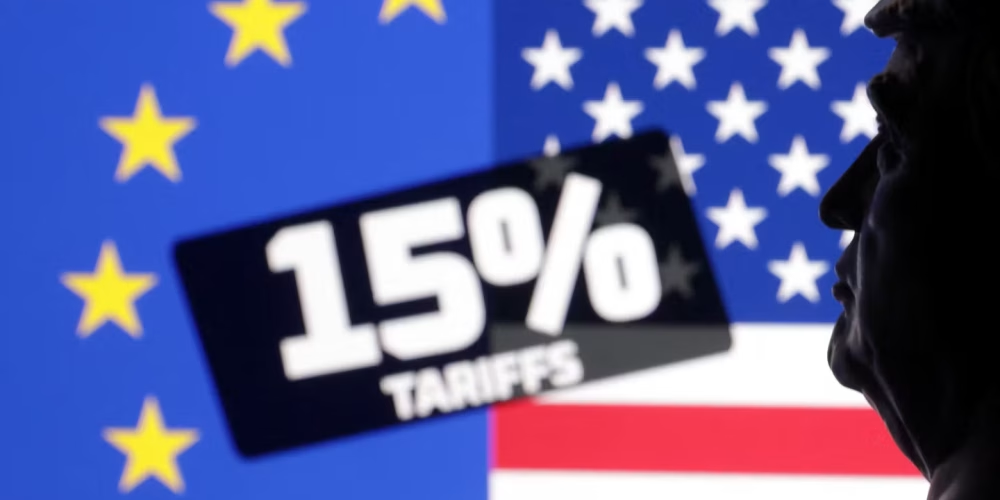
- The United States government is offering specific tariff relief to European companies that agree to shift production and investment to American soil.
- While these exemptions provide a temporary reprieve from high import duties, they require long-term commitments that could hollow out Europe’s industrial base.
- European business leaders are navigating a difficult balance between maintaining their domestic operations and securing access to the essential American consumer market.
Industrial leaders across Europe are currently grappling with a transformative shift in global trade dynamics as the United States implements a “carrots and sticks” approach to import duties. Recent policy shifts from Washington have introduced steep tariffs on foreign goods, but a new system of exemptions offers a potential escape for companies willing to play by American rules. This development has created a strategic dilemma for some of the continent’s most iconic manufacturing brands, who must now weigh the costs of new taxes against the risks of moving their operations overseas.
The current American administration has signaled that tariff relief is not a universal guarantee but rather a conditional reward for corporate cooperation. To qualify for these sought-after exemptions, European firms are often expected to increase their capital expenditures within the United States. This includes building new factories, expanding existing assembly lines, and hiring American workers. For many executives, the choice is becoming increasingly binary: relocate production to stay competitive in the U.S. or remain in Europe and face price hikes that could alienate their American customer base.
While the prospect of avoiding tariffs is a short-term win for corporate balance sheets, the underlying conditions carry a significant “sting.” Experts suggest that these requirements function as a vacuum, pulling investment away from the European Union and toward North America. This trend threatens to accelerate the deindustrialization of Europe, as companies prioritize American expansion to ensure market access. The ripple effects could lead to reduced innovation and job losses in traditional European industrial hubs that have historically relied on exports to drive growth.
In response to these pressures, European trade officials are attempting to negotiate a more balanced framework. However, the leverage remains largely with Washington, which continues to use market access as a primary tool of economic diplomacy. The situation is particularly acute for the automotive, chemical, and machinery sectors, where the U.S. remains the single most important export destination. For these industries, the cost of being locked out of the American market is far higher than the cost of setting up new facilities across the Atlantic.
The reaction from the European business community is mixed, with some viewing the move as an inevitable evolution of global supply chains. Some firms have already begun announcing major investment projects in states like South Carolina and Georgia, citing the need to be closer to their customers and shielded from geopolitical volatility. These companies argue that a local presence in the U.S. is no longer optional but a fundamental requirement for survival in a fragmented global economy.
Conversely, critics argue that this policy undermines the spirit of free trade and places an unfair burden on medium-sized enterprises. Unlike multinational giants, smaller European manufacturers often lack the capital necessary to establish a physical footprint in the United States. For these businesses, the new tariff regime represents a significant barrier to entry that could permanently stifle their international growth. The lack of a unified European response has further complicated the matter, as individual countries compete to keep their own industries from migrating.
As the deadline for various tariff implementations approaches, the pressure on European boardrooms continues to mount. The decisions made in the coming months will likely reshape the industrial landscape of the continent for decades to come. While the immediate goal for many is to secure tariff relief and protect quarterly profits, the long-term cost may be a permanent shift in the center of gravity for global manufacturing. The “sting in the tail” of these exemptions serves as a reminder that in the modern era of trade, every concession comes with a price.









