

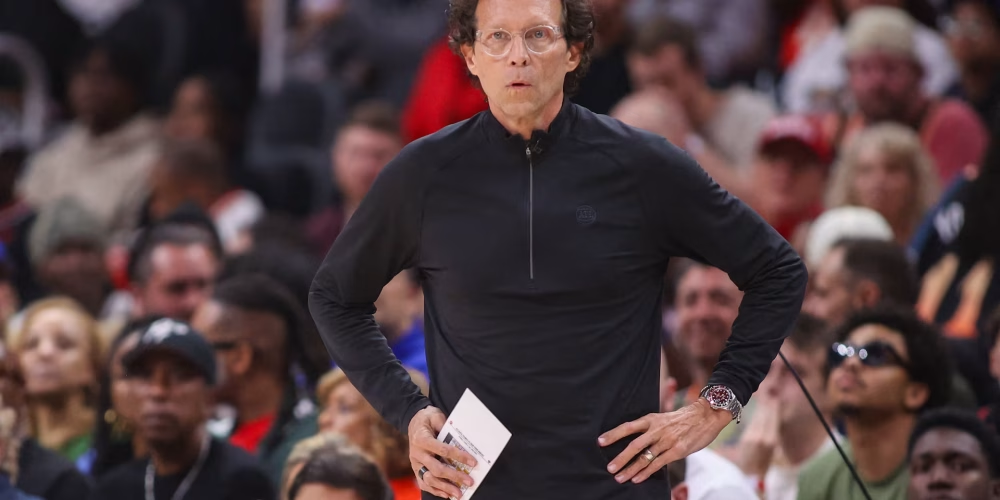
KEY POINTS
- The Atlanta Hawks have finalized a multi-year contract extension with head coach Quin Snyder following a successful 46-win regular season.
- The agreement secures leadership stability just weeks after the promotion of Onsi Saleh to president of basketball operations.
- Under Snyder’s direction, the team successfully navigated a major roster overhaul while capturing the Southeast Division title.
The Atlanta Hawks have solidified their long-term coaching situation by locking in head coach Quin Snyder with a substantial multi-year contract extension. This announcement follows a highly competitive campaign where Atlanta surpassed external expectations, finishing the regular season with a 46-36 record. By extending the veteran coach, the franchise signaling its complete commitment to his strategic vision and player development program.
What You Need to Know
Quin Snyder originally took the reins in Atlanta during the latter portion of the 2022-23 season, transitioning back to the NBA sidelines after a highly respected eight-year tenure leading the Utah Jazz. During his time in Utah, Snyder built a reputation for defensive discipline and consistent postseason appearances, a pedigree that the Hawks sought to replicate. His arrival in Atlanta brought an immediate emphasis on structural culture and systematic player growth, elements that the front office felt were necessary for a maturing roster.
The extension represents a broader organizational push toward absolute stability. It directly mirrors a parallel move made late last month when the franchise elevated general manager Onsi Saleh to president of basketball operations, executing a long-term contract to keep him at the helm of the front office. By securing both their primary executive and their head coach simultaneously, the Hawks are attempting to build an enduring culture capable of sustained success in a highly volatile Eastern Conference.
Snyder’s coaching style has already yielded unique historical achievements in player development. He recently became the first head coach in NBA history to oversee back-to-back winners of the league’s Most Improved Player award, with Dyson Daniels securing the honor in 2024-25 and Nickeil Alexander-Walker winning it for the 2025-26 season. This track record underscores the front office’s confidence that the current young roster will continue to ascend under his direct supervision.
Rebuilding on the Fly in Atlanta
The true testament to Quin Snyder’s coaching execution came during a highly tumultuous 2025-26 season defined by extensive roster turnover. In January, the franchise made the monumental decision to shift away from its previous era, trading away four-time All-Star guard Trae Young to the Washington Wizards. In return, the Hawks brought in seasoned veterans and complementary pieces like CJ McCollum and Corey Kispert, fundamentally changing the team’s on-court identity mid-season.
Rather than collapsing after parting ways with their franchise centerpiece, the Hawks thrived under the adjusted parameters. Snyder re-engineered the team’s offensive and defensive spacing, prompting a sensational late-season surge. Atlanta concluded the regular season by winning 19 of their final 24 contests, an elite stretch that propelled them to their first outright Southeast Division title since the 2020-21 season.
Along this impressive stretch, Snyder hit a major personal milestone in March by securing his 500th career NBA head coaching victory, cementing his status among the top tier of active professional coaches. Though the team’s postseason journey was cut short in April via a competitive six-game first-round exit against the formidable New York Knicks, the Hawks proved their mettle by being the only team to hand the Knicks a postseason loss up until the later rounds of the playoffs.
Why This Matters
For professional basketball enthusiasts and local sports economies across the United States, this move underlines how modern sports franchises manage massive transitions without resorting to multi-year losing strategies. The Hawks demonstrated that an organization can trade away an elite All-Star player, retool the roster, and immediately improve their winning percentage. This blueprint provides a highly compelling case study for small- and mid-market sports franchises looking to maintain consumer engagement and ticket sales while shifting structural directions.
Furthermore, this decision impacts the broader financial landscape of professional coaching. Premium leadership in the NBA has increasingly commanded substantial eight-figure annual salaries, a benchmark set by recent coaching extensions across the league. By stepping up to market rates to retain an elite tactical mind, Atlanta’s ownership group is sending a clear message to the local business community, corporate sponsors, and regional broadcast partners that they are actively investing capital to maintain a premium entertainment product.
NCN Analysis
Securing Quin Snyder long-term is a calculated, high-reward move for an Atlanta franchise that has historically struggled with operational consistency. By pairing Snyder with Onsi Saleh for the foreseeable future, ownership has eliminated the organizational friction that frequently dooms transitioning franchises. Snyder has proven that he can maximize internal talent, and his elite player development metrics mean the team will not have to rely solely on high-priced free agency to improve.
The next critical phase for readers to watch is how this unified leadership group approaches the upcoming draft and free agency periods. Armed with the flexibility gained from their winter roster trades, Saleh and Snyder now possess the structural alignment needed to target specific players who fit Snyder’s precise tactical system. The pressure will shift swiftly from overachieving underdogs to consistent conference contenders, and Snyder’s ability to adjust his postseason tactical schemes will ultimately dictate whether the Hawks can breach the upper echelon of the Eastern Conference.
The long-term extension of Quin Snyder ensures that the Atlanta Hawks possess the cultural foundation and elite tactical leadership required to navigate their ambitious post-rebuild era.
Reported by the NCN Editorial Team









