

KEY POINTS
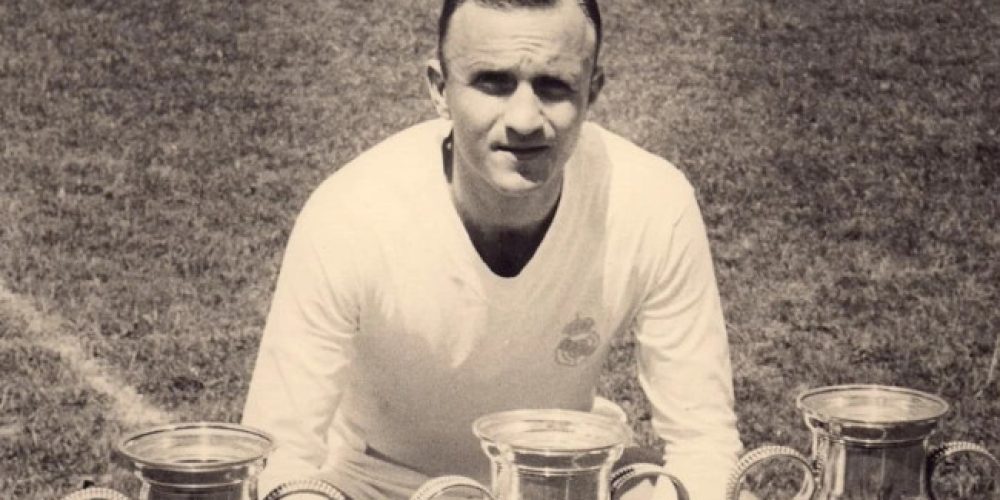
- Jose Santamaria, the legendary Uruguayan-Spanish defender who anchored Real Madrid’s historic defense in the 1950s and 60s, has died.
- Known as “The Wall,” Santamaria was a pivotal figure in the squad that secured four European Cups during the club’s golden era of dominance.
- Beyond his playing career, Santamaria left a lasting legacy as a coach, famously leading the Spanish national team during the 1982 World Cup.
The global soccer community is in mourning following the announcement that Jose Santamaria, one of the most decorated defenders in the history of the sport, has passed away at the age of 96. A titan of the game who defined the art of central defending, Santamaria was the backbone of a Real Madrid side that transformed the club into a global powerhouse. His death marks the end of an era for the “Merengues,” as they lose one of the final living links to the most successful period in their storied history.
What You Need to Know
Jose Santamaria was born in Montevideo, Uruguay, and first rose to prominence with Nacional, where he established himself as a physical and intelligent force on the pitch. His performances for the Uruguayan national team during the 1954 World Cup caught the attention of European scouts, eventually leading to his move to the Spanish capital in 1957. At a time when international transfers were rare and difficult, Santamaria’s transition to Real Madrid was a landmark moment for the club’s defensive recruitment.
Upon arriving in Madrid, he joined a legendary lineup that included icons like Alfredo Di Stefano and Ferenc Puskas. While those players were celebrated for their offensive brilliance, Santamaria was the defensive anchor that allowed them the freedom to attack. During his nine seasons with the club, he helped secure six La Liga titles and four European Cups. His playing style earned him the nickname “The Wall,” a testament to his ability to read the game and his uncompromising physical presence in the penalty area.
After hanging up his boots, Santamaria transitioned into management with a deep understanding of the tactical evolution of the game. He coached Espanyol before taking the reins of the Spanish national team. His tenure as the manager of “La Roja” culminated in the 1982 World Cup hosted on Spanish soil. Although his coaching career was marked by the intense pressure of the Spanish media, he remained a respected figure across the footballing world for his integrity and profound knowledge of the sport.
The Enduring Legacy of a Footballing Titan
The passing of Jose Santamaria has triggered a wave of tributes from the highest levels of the sport. Real Madrid issued a heartfelt statement describing him as a “legend of world football” and an example of the values the club strives to represent. His career was characterized by a rare longevity; he played at the top level well into his thirties, a feat that was almost unheard of in the 1960s given the lack of modern sports medicine and nutrition.
Santamaria was unique in that he represented two different national teams during his career. After earning 20 caps for Uruguay, he went on to represent Spain 16 times after obtaining citizenship. This dual international career allowed him to bridge the gap between South American flair and European tactical discipline. He was often cited by subsequent generations of defenders—including Real Madrid legends like Fernando Hierro and Sergio Ramos—as a blueprint for the modern center-back.
His influence extended beyond the pitch through his work with the Real Madrid veterans’ association, where he spent decades mentoring younger players. Santamaria was known for his humility and his refusal to engage in the hyperbole of modern sports media. He often remarked that his primary job was simply to make the game easier for his teammates, a philosophy that endeared him to generations of fans who appreciated the “unseen work” of a world-class defender.
In recent years, Santamaria had remained a fixture at the Santiago Bernabeu, often seen at major club events and European nights. His presence served as a constant reminder of the club’s pedigree and the standards required to wear the white shirt. As Real Madrid continues its current era of success, the foundation laid by Santamaria’s generation remains the benchmark for excellence. The club has announced that a moment of silence will be observed in his honor during their next home fixture.
Why This Matters
For soccer fans in the United States and globally, Santamaria’s passing is a reminder of the roots of the modern “superclub” phenomenon. The Real Madrid we recognize today—a global brand with a massive following in North America and Europe—was built on the successes achieved by Santamaria and his contemporaries. Their dominance in the early years of the European Cup established the prestige of continental competition, which has evolved into the multi-billion dollar industry known today as the UEFA Champions League.
Furthermore, Santamaria’s journey as an immigrant athlete who became a national hero in his adopted country is a narrative that resonates deeply with the diverse fanbases of modern sports. His ability to adapt to a new culture and language while maintaining his status as a world leader in his profession remains an inspiring story. As the U.S. prepares to co-host the 2026 World Cup, reflecting on the lives of pioneers like Santamaria helps connect new generations of fans to the historical tapestry of the world’s most popular sport.
NCN Analysis
The loss of Santamaria is significant because he was a master of a “lost art” in defending. In the modern era of high-pressing and ball-playing center-backs, Santamaria’s pure focus on positioning, aerial dominance, and man-marking is often overlooked. However, tactical analysts often point to his 1960 European Cup final performance as a masterclass in defensive organization. As football continues to evolve, there is an argument that the pendulum is swinging back toward the need for the kind of specialized “stopper” that Santamaria embodied.
We expect that Real Madrid will honor Santamaria by further immortalizing him within the club’s museum and potentially naming a youth academy pitch in his honor. For the Spanish national team, his death serves as a moment to reflect on the 1982 World Cup, a tournament that, while disappointing on the pitch for Spain, was a massive success in modernizing the country’s footballing infrastructure. Santamaria was a bridge between the classic and modern eras of the game, and his influence will be felt as long as the ball is rolling.
The game has lost a giant, but “The Wall” will forever remain a cornerstone of football history.









