KEY POINTS
- The Iranian Sports Ministry has prohibited all national and club teams from traveling to countries labeled as hostile.
- Officials cited the inability of those nations to guarantee the security of Iranian athletes as the primary reason for the ban.
- The directive requires sports federations to coordinate with international bodies like the AFC to relocate upcoming matches.
Iran has issued a sweeping ban on its national and club sports teams traveling to countries it considers hostile. The Iranian Sports Ministry announced the decision on Thursday, citing significant concerns regarding the safety and security of its athletes. This directive remains in effect until further notice as regional tensions continue to impact international sporting schedules.
The ministry stated that any country unable to provide ironclad security for Iranian delegation members is now off-limits. This move aims to protect athletes and staff from potential threats during a period of heightened geopolitical instability. The announcement follows reports of a scheduled match involving an Iranian club team in a location now deemed unsafe.
Specific mention was made of the football club Tractor FC and its upcoming Asian Champions League Elite fixtures. The team was originally slated to play a match against an Emirati opponent in Saudi Arabia. Under the new rules, the Iranian Football Federation must now work with the Asian Football Confederation to find a neutral venue.
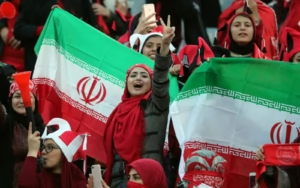
This travel restriction comes at a critical time for Iranian sports on the global stage. The national men’s football team has already qualified for the 2026 FIFA World Cup. That tournament is scheduled to take place across the United States, Canada, and Mexico starting this June.
The ban does not explicitly name the United States, but tensions between the two nations have cast a shadow over World Cup preparations. Iranian officials have previously suggested moving their group-stage matches from the U.S. to Mexico. They cited the “life and safety” of their players as the core motivation for requesting a venue change.
FIFA and the Asian Football Confederation are now facing logistical challenges due to these new requirements. Relocating high-profile matches on short notice requires significant coordination between host nations and security agencies. The goal is to ensure that international competitions can proceed without compromising the safety of participants.
The Sports Ministry emphasized that the responsibility for notifying international bodies lies with individual federations and clubs. They must provide clear evidence of why a specific host country is considered hostile or insecure. This process is expected to trigger several emergency meetings within various international sports organizations.
Regional conflicts have already led to the postponement or relocation of several major sporting events this year. Analysts suggest that this formal ban codifies a practice that was already becoming common due to security risks. The Iranian government maintains that it will not compromise on the well-being of its citizens abroad.
The impact of this decision extends beyond football to all professional and amateur sports delegations. Athletes in individual disciplines like wrestling, weightlifting, and volleyball may also face travel restrictions for upcoming qualifiers. This could potentially affect Iran’s overall standing and participation in various international rankings.
The international sporting community is currently monitoring the situation to see how many countries will be officially labeled as hostile. For now, the focus remains on finding neutral grounds that satisfy the safety requirements of the Iranian ministry. These diplomatic and logistical hurdles continue to complicate the intersection of global sports and regional politics.