KEY POINTS
- Investigations into recent Tesla Cybertruck crashes reveal a pattern of high-intensity battery fires and electronic door failures.
- Critics and legal filings allege that the vehicle’s unique design, including reinforced “armor glass,” prevents emergency rescues during thermal runaway events.
- Multiple wrongful death lawsuits have been filed against Tesla, claiming that the truck’s safety features turn survivable accidents into fatal infernos.
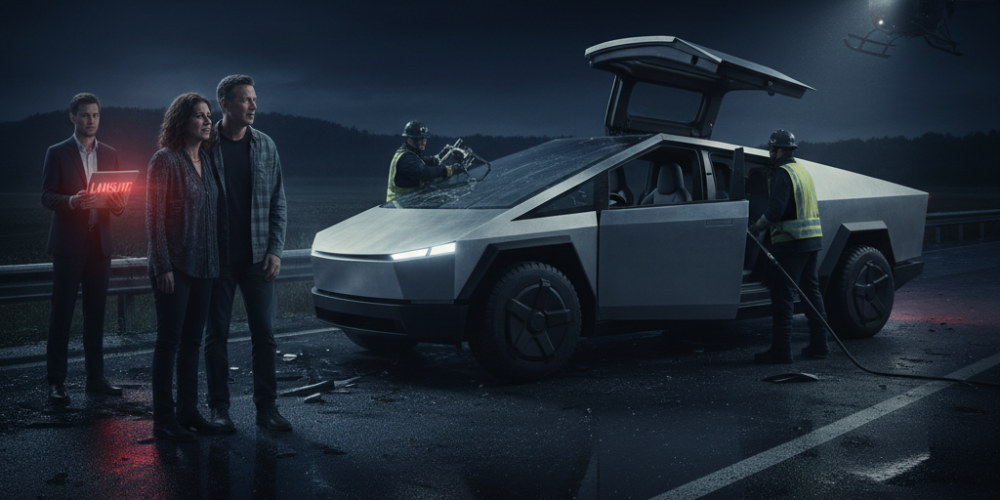
The Tesla Cybertruck is facing intense scrutiny following a series of violent crashes that resulted in uncontrollable battery fires and passenger fatalities. Investigative reports indicate that the vehicle’s “apocalypse-proof” design may actually pose a significant danger during emergency situations. Families of victims have begun filing lawsuits, alleging that the truck’s construction makes it nearly impossible for occupants to escape after an impact.
At the center of the controversy is the phenomenon known as thermal runaway, where lithium-ion battery cells overheat and ignite in a self-sustaining chain reaction. These fires burn at temperatures exceeding 5,000°F, which is significantly hotter than traditional gasoline fires. Emergency responders have reported that the Cybertruck‘s battery packs frequently reignite hours after the initial blaze appears to be extinguished.
The truck’s specialized safety features, such as high-density laminated windows and electronic door handles, are also under fire. In several documented cases, the vehicle’s power system failed upon impact, rendering the electronic latches useless. Rescuers and witnesses reported being unable to break the reinforced glass or open the doors, leaving passengers trapped inside the burning cabin.
Legal experts and safety advocates point to a disproportionate number of deaths relative to the Cybertruck’s limited production numbers. While Tesla has sold approximately 60,000 units since its debut, the Guardian has tracked five major fire incidents involving the model. Four of these incidents resulted in fatalities, including a high-profile case where three college students died in California.
Tesla’s own emergency response guidelines highlight the difficulty of managing these specific fires. The company recommends using between 3,000 and 8,000 gallons of water applied directly to the battery to stop a blaze. However, firefighters have found that even massive amounts of water are often insufficient to halt the chemical reaction once it begins.
One harrowing account details a driver in Los Angeles who survived only after a fire hydrant was sheared off during the crash, dousing the vehicle. Despite the constant flow of water, the driver reported that the interior felt like a sauna and the doors remained locked. He eventually lost consciousness before being pulled to safety through a broken window.
The lawsuits currently facing Tesla argue that the company was aware of these design flaws for years. Plaintiffs claim that the manual door overrides are hidden and nearly impossible to locate in a smoke-filled cabin. They argue that these “minimalist” design choices prioritize aesthetics over basic human survivability in extreme scenarios.
As federal regulators begin to take a closer look at electric vehicle safety standards, the Cybertruck serves as a focal point for the debate. The combination of hyper-volatile battery chemistry and inaccessible cabins has raised questions about the future of EV design. Industry analysts suggest that these incidents could lead to mandatory changes in how emergency releases are implemented.
Tesla has not issued a formal statement addressing the specific allegations found in the recent wrongful death filings. The company continues to market the Cybertruck as one of the safest vehicles on the road, citing its stainless-steel exoskeleton. However, for the families involved in these tragedies, the “indestructible” nature of the truck is precisely what led to their loss.
The outcome of these legal battles may influence safety regulations for the entire electric vehicle industry. As more Cybertrucks enter the market, the pressure on Tesla to address these mechanical and structural concerns continues to mount. For now, safety experts advise owners to keep emergency glass-breaking tools within reach inside the cabin.